Abbotsford sits on a complex sedimentary fan where the Fraser River meets the uplands, leaving behind thick deposits of loose to medium-dense sands and silty sands. The water table across the Sumas Prairie and Clearbrook area often sits barely two metres below grade, which makes any deep compaction effort a balancing act between effective drainage and preventing liquefaction. When you’re dealing with a loose granular profile and the National Building Code of Canada (NBCC) mandates a post-improvement relative density of at least 70 percent under seismic design category D, the vibrocompaction design has to account for grain size distribution, fines content, and the actual energy attenuation of the vibrator at depth. We’ve seen sites where standard penetration resistance jumps from an N-value of 8 to over 25 after a well-executed design, and that difference translates directly into allowable bearing pressures above 200 kPa without resorting to deep foundations. For fine-grained lenses that won’t densify by vibration alone, we often pair the vibro strategy with targeted grouting to fill the gradation gap and create a uniformly improved mass.
A vibrocompaction grid in Abbotsford alluvium can push SPT N-values from single digits to 25-plus, turning marginal ground into a competent bearing stratum without importing fill.
Local ground factors
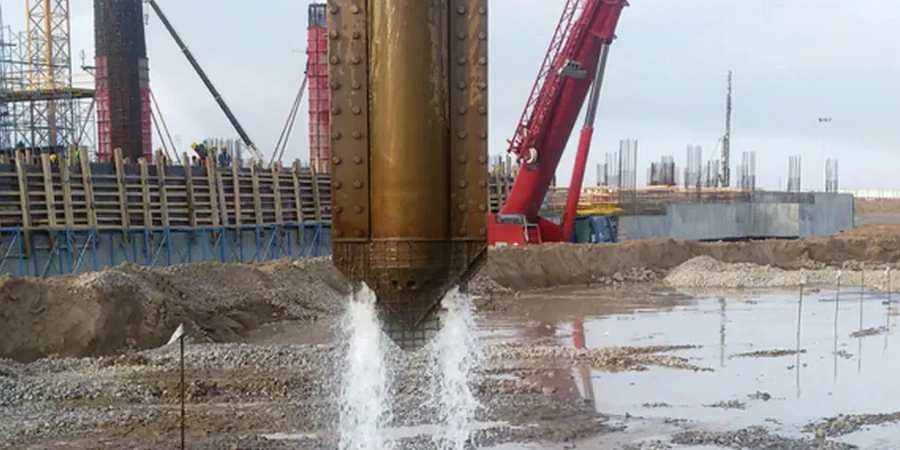
The rig itself is a lattice-boom crane suspending an electric vibrator the size of a small torpedo, with water jets at the nose that fluidize the sand just enough to let the probe sink under its own weight. In Abbotsford, where the aquifer feeds dozens of agricultural wells, the biggest risk isn’t the machine—it’s the possibility of fines migration into the gravel pack of a nearby irrigation well if the injection rate isn’t dialled in precisely. We’ve adopted a stepped ramping protocol that starts at 0.3 m³ per metre and only increases if penetration rate drops below 0.5 m/min, keeping the pore pressure transient localized. Another hazard unique to this valley is the presence of buried organic lenses from old Sumas Lake sediments; if the vibrator hits a peat pocket, it can lose side support and lean, so the design always includes a reconnaissance CPT grid on a 15-metre offset before the compaction rig moves in. The seismic design in Abbotsford also requires post-treatment shear wave velocity profiles to confirm the site class upgrade, typically from Class E or D to Class C, which feeds directly into the structural engineer’s base shear calculation.
Regulatory framework
NBCC 2020 Division B, Part 4 — Seismic Design, CSA A23.3:19 — Design of Concrete Structures (foundation subgrade references), ASTM D1586-18 — Standard Test Method for Standard Penetration Test (SPT), ASTM D5778-20 — Standard Test Method for Electronic Friction Cone and Piezocone Penetration Testing (CPTu, post-treatment verification)
Common questions
How long does a vibrocompaction design and field program take for a typical 2-acre site in Abbotsford?
The investigation and design phase usually runs three to four weeks from the first CPT sounding to the stamped design report. Field compaction for a 2-acre footprint with 2.4 m triangular spacing typically takes six to eight working days, plus another four days for post-treatment CPT verification. If retreatment is needed in isolated zones, add two to three days. The total timeline from mobilization to final report is generally five to seven weeks, assuming dry weather and no archaeological holds.
What is the cost range for vibrocompaction design and verification on a mid-size commercial lot?
For a half-acre to full-acre commercial parcel in Abbotsford, the combined design, field supervision, and post-treatment verification report usually falls between CA$1,940 and CA$6,400. The spread depends on the number of CPT soundings, whether shear wave velocity testing is required for the seismic site class upgrade, and the complexity of the stratigraphy. The compaction rig and crew cost is separate and quoted by the specialty contractor.
Can vibrocompaction eliminate the risk of liquefaction under Abbotsford’s seismic design category?
Yes, when the granular soil is clean enough to densify by vibration. The NBCC requires a post-treatment relative density of 70 percent or higher, confirmed by CPT tip resistance exceeding 12 MPa, to classify the ground as non-liquefiable under the design earthquake. If the fines content exceeds 15 to 20 percent, pure vibratory compaction may not achieve that threshold, and we’ll recommend a hybrid approach with stone columns. The post-treatment shear wave velocity profile is the definitive piece of evidence for the structural engineer’s base shear calculation.