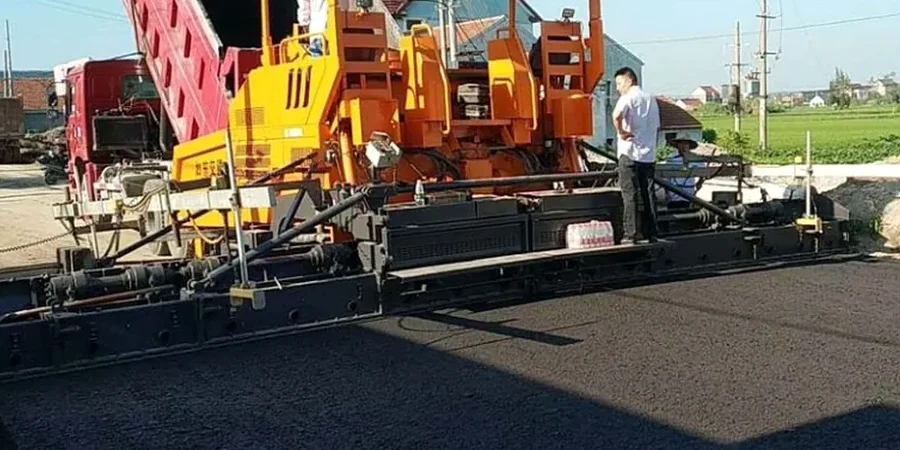
Designing a road in Abbotsford means dealing with two completely different soil profiles depending on which side of Sumas Mountain you're working on. The Sumas Prairie side gives you those deep, compressible silty clays that settle for years if you don't treat them right, while the upland benches closer to Clearbrook sit on dense glacial till that drains well but can be brutally hard to grade. We see projects go sideways when designers apply a generic cross-section without accounting for that contrast. Before locking in the pavement structure, we run subgrade characterization — CBR testing on the clay-rich sections and Proctor compaction to nail the density targets on the granular fills. The pavement design has to work with the soil, not against it, and in the Fraser Valley that means understanding the water table swings that come with every rainy season.
A pavement is only as good as the subgrade it sits on — in Abbotsford's wet winters, drainage design determines service life more than asphalt thickness ever will.
Common questions
What does flexible pavement design cost in Abbotsford?
For a typical commercial or industrial project in Abbotsford, the geotechnical investigation and pavement design package runs between CA$2,460 and CA$7,010 depending on site size, number of borings, and whether seasonal groundwater monitoring is included.
How does Abbotsford soil affect pavement performance?
The Sumas Prairie clays are highly moisture-sensitive — their resilient modulus can drop by 40% or more between dry summer conditions and saturated winter conditions. The gravelly upland soils drain better but can be stiff enough to cause reflective cracking if the asphalt thickness isn't adequate.
What's the difference between flexible and rigid pavement for Abbotsford conditions?
Flexible pavement handles differential settlement better, which matters on the compressible Sumas silts. Rigid pavement resists deformation under heavy point loads but cracks if the subgrade settles unevenly. For most local industrial applications, flexible pavement with a well-compacted granular base gives better long-term value.
How long does a properly designed flexible pavement last in the Fraser Valley?
With proper subgrade preparation and drainage, a flexible pavement designed for the correct traffic loading should reach its 20-year design life without major structural rehabilitation. The weak link is almost always water infiltration into the base course — get the drainage right and the pavement holds up.
Do you need a geotechnical investigation for a parking lot pavement design?
Yes, even for a parking lot. We've seen lots in Abbotsford fail within five years because the designer assumed a uniform subgrade that didn't exist. Two borings and CBR tests cost a small fraction of tearing out and rebuilding a failed lot.