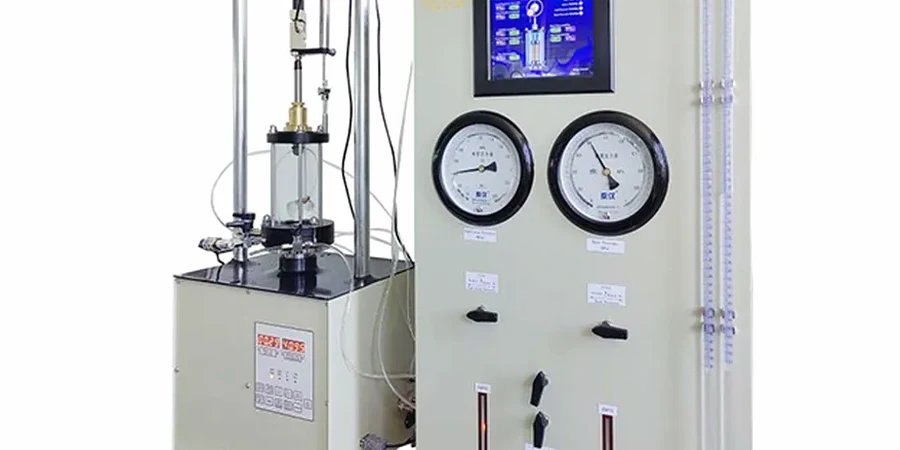
Abbotsford’s expansion eastward from the historic Clayburn brickworks onto the Sumas Prairie and adjacent uplands brought a unique geotechnical puzzle into focus. The city sits at the collision of the Fraser River lowlands and the Cascade foothills, where soil conditions can shift from dense glacial till to soft, compressible silts within the span of a single lot. For any engineered structure here, the shear strength parameters of the foundation soil are not generic assumptions. We run the triaxial test to extract the friction angle and cohesion values that directly feed into bearing capacity and slope stability models under the NBCC framework. On a recent project near the Sumas border crossing, where the water table sits barely 1.5 m below grade, the difference between an unconsolidated undrained test and a consolidated drained test was a factor of safety swing from 1.0 to 1.8. That is the margin between a working foundation and a legal dispute. When the site stratigraphy includes the Abbotsford-Sumas aquifer sediments, we often pair the triaxial program with a grain-size analysis to verify the fines content before selecting the appropriate drainage conditions for the test sequence.
In the Sumas clay, an effective friction angle of 28 degrees with a cohesion intercept of 5 kPa is the difference between a safe excavation and a blowout.
Process and scope
On the Sumas Mountain slopes, we consistently see overconsolidated clay tills that look competent in a hand specimen but fail quickly once pore pressure builds during undrained loading. A triaxial test here reveals the true effective stress path. Our lab runs three standard protocols depending on the construction timeline and drainage conditions. Consolidated Undrained testing with pore pressure measurement provides both total and effective stress envelopes for short-term stability analysis. Consolidated Drained testing, which can run for several days on silty samples from the Matsqui Prairie, yields the drained friction angle critical for long-term settlement and retaining wall design under the CSA A23.3 concrete code. Unconsolidated Undrained tests give us a rapid undrained shear strength for preliminary excavation support in the Sumas clay unit. Every specimen is trimmed to a diameter of 35 mm or 50 mm from Shelby tube samples, saturated using a back-pressure technique, and sheared at a rate determined by the consolidation characteristics of the material. The cell pressure and back pressure transducers are calibrated to ASTM D4767 tolerances, and we log axial strain, deviator stress, and excess pore pressure at 0.01% strain increments. The failure envelope is then plotted using Mohr circles from three effective confining pressures, typically 100, 200, and 400 kPa for the valley sediments.
Local ground factors
The Sumas Prairie was once a lakebed, drained in the 1920s, and the lacustrine silts and clays that remain are classic candidates for strain-softening behavior. A peak strength envelope from a triaxial test on an undisturbed sample might suggest a bearing capacity of 250 kPa, but the post-peak residual strength can drop by 40% or more once failure planes develop. In a seismic event, Abbotsford falls within NBCC seismic hazard zone, and the cyclic loading on these sensitive silts can trigger significant pore pressure accumulation. An undrained triaxial test with pore pressure measurement quantifies the excess pore pressure ratio at failure, which directly informs the liquefaction potential assessment for the site. Ignoring the strain-softening tendency of the local Sumas clay unit has led to differential settlements exceeding 100 mm in light industrial buildings near the airport, where the footing design relied on a single undrained shear strength value without considering the post-peak reduction. The triaxial program, when designed with the site geology in mind, prevents this class of failure.
Common questions
Does the triaxial test provide different strength values than a pocket penetrometer or unconfined compression test?
Yes, significantly. A pocket penetrometer or unconfined compression test on a Sumas clay sample will give an approximate undrained shear strength, but without confining pressure the result is unreliable for depth. The triaxial test consolidates the specimen to the in-situ effective stress and then shears it under controlled drainage. The friction angle from a triaxial test is an intrinsic material property used in finite element models, not an index value.
What is the typical cost range for a triaxial test program in Abbotsford?
For a standard set of three specimens at different confining pressures, the cost range is CA$2,600 – CA$3,900 depending on the test type (CIU, CD, or UU) and the consolidation stress history of the material. A full effective stress envelope with three Mohr circles is the minimum for a defensible design in the Fraser Valley.
How long does a triaxial test take from sample receipt to the final report?
A Consolidated Undrained test with pore pressure measurement typically requires 7 to 10 working days, including saturation, consolidation, and shearing stages. A Consolidated Drained test on the Matsqui silts can extend to 14 days because the shearing rate must be slow enough to prevent pore pressure buildup. We provide the deviator stress versus axial strain curves and the Mohr-Coulomb failure envelope with the report.