← Home · Foundations

Pile Foundation Design in Abbotsford – Deep Foundations for Fraser Valley Soils

Together, we solve the challenges of tomorrow.

LEARN MORE →

We consistently encounter foundation challenges in Abbotsford where shallow footings simply cannot transfer structural loads safely through the soft silts and peats that blanket much of the Sumas Prairie and lower Matsqui areas. The Fraser Valley’s post-glacial depositional history left behind thick sequences of compressible organic soils—sometimes exceeding eight meters in depth—overlying dense glacial till or bedrock at highly variable elevations. Pile foundation design becomes the only rational solution when bearing strata sit well below the zone of seasonal moisture fluctuation and liquefiable sand lenses appear in the upper 15 meters. Our laboratory and field team combines CPT testing data with soil strength parameters extracted from undisturbed Shelby tube samples to calibrate side friction and end-bearing predictions that match the real stratigraphy beneath each Abbotsford site, rather than relying on generic textbook values that rarely hold across the Fraser Lowland.

Axial pile capacity in Abbotsford is controlled more by pore pressure dissipation rates in the surrounding silt matrix than by the undrained strength of the clay alone.

Process and scope

Abbotsford’s development arc—from agricultural township to one of British Columbia’s fastest-growing cities—pushed construction onto marginal lands that earlier generations avoided. The clay-rich glaciolacustrine deposits underlying Clearbrook and the Sumas Mountain foothills exhibit pronounced strain-softening behavior when remolded during pile driving, which demands careful selection between driven steel H-piles, closed-end pipe piles, and cast-in-place bored piles depending on the sensitivity of the formation. We run consolidated-undrained triaxial tests on specimens trimmed from thin-walled tube samples to capture the undrained shear strength profile that governs shaft adhesion. For the coarse granular interbeds that often appear below 20 meters, drained direct shear tests on reconstituted samples provide the friction angles needed to compute end-bearing capacity using the modified Meyerhof method. When lateral loads from seismic or wind govern the pile group configuration, we supplement the investigation with MASW surveys to constrain shear-wave velocity profiles for p-y curve generation and liquefaction triggering analysis per the NCEER workshop recommendations adopted in the Fraser Valley context.
Pile Foundation Design in Abbotsford – Deep Foundations for Fraser Valley Soils
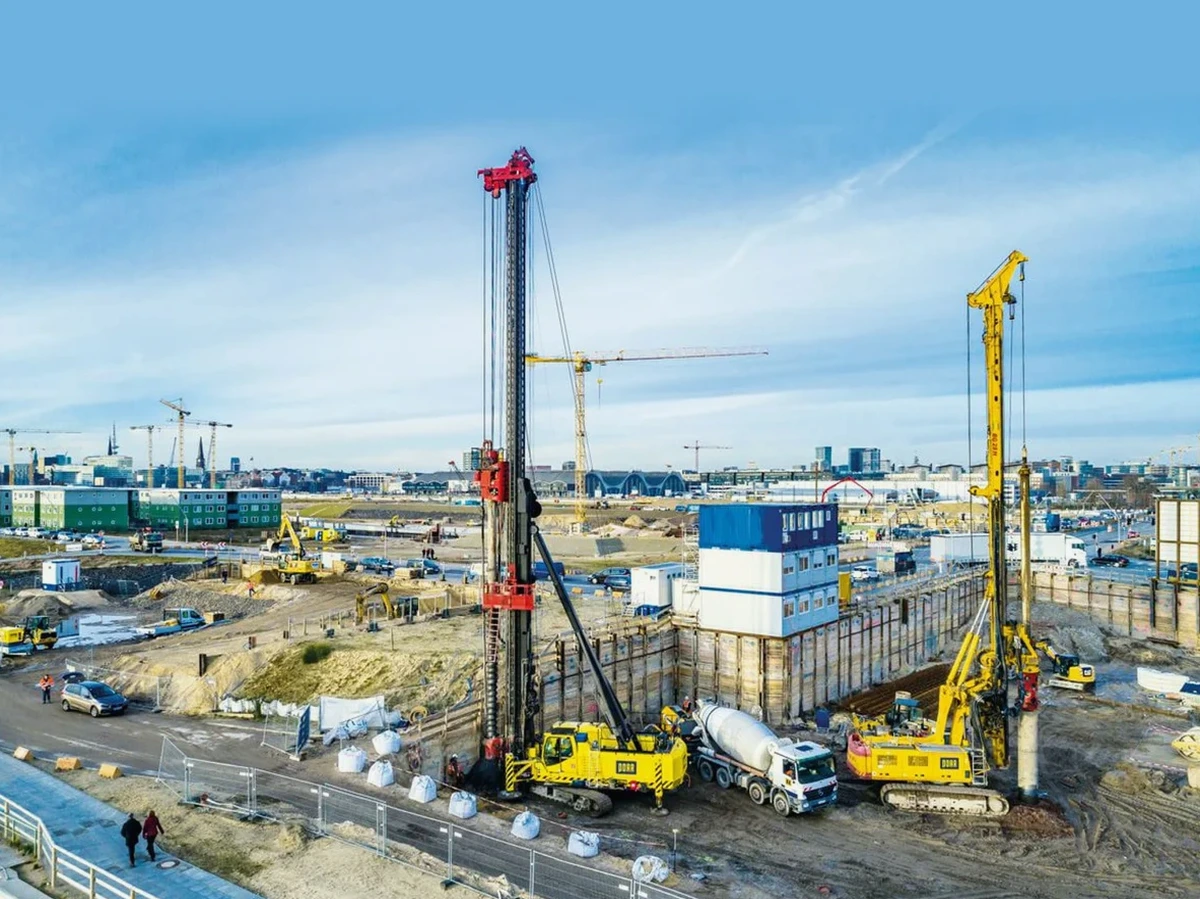
Technical reference image — Abbotsford

Local ground factors

The Sumas Prairie subsurface hides a notorious risk: isolated sand and silt lenses confined between low-permeability clay layers that generate excess pore pressure during pile installation and remain under-drained for weeks. If the pile foundation design does not account for this temporary loss of effective stress, the short-term shaft capacity can be less than half of the long-term drained value—a discrepancy that field load tests on instrumented piles in east Abbotsford have repeatedly confirmed. A second hazard stems from the Sumas Fault and the broader Cascadia subduction zone influence, which subjects deep foundations to cyclic axial and lateral demands that degrade skin friction in sensitive clays. Our design approach explicitly separates short-term installation conditions from long-term service conditions and seismic load cases, applying adhesion factors calibrated to the sensitivity ratio measured in the laboratory rather than the default values embedded in simplified design charts.

Need a geotechnical assessment?

Reply within 24h.

Email: contact@geotechnicalengineering.xyz

Reference parameters

ParameterTypical value
Design standard for axial capacityNBCC 2020 with CSA S6:19 Section 6 foundations
Soil sampling method for lab testingShelby tubes (ASTM D1587) in cohesive strata; SPT split spoon in granular layers
Laboratory strength testsCIU triaxial (ASTM D4767), unconfined compression (ASTM D2166), direct shear (ASTM D3080)
Lateral load analysis inputShear-wave velocity (Vs) profile, p-y curves per Reese & Matlock
Settlement evaluationt-z curves and equivalent top-down load-transfer method
Liquefaction assessment depthUpper 20 m, SPT-based with fines content correction (Youd et al. 2001)
Typical pile types evaluatedDriven H-pile, closed-end pipe, CFA bored pile, micropile for restricted access

Complementary services

01

Axial pile capacity analysis

We compute shaft friction and end-bearing resistance using the beta method for drained loading and the total stress alpha method for short-term conditions, with parameters derived from site-specific lab testing rather than empirical correlations.

02

Lateral load and p-y analysis

For pile groups subject to seismic or wind loading in Abbotsford’s soft upper soils, we generate site-specific p-y curves using LPILE or GROUP, fed by Vs profiles and undrained shear strength data from our triaxial program.

03

Pile load test interpretation

We design static and dynamic load test programs and back-analyze measured load-settlement curves to validate or refine design parameters, including setup factors for driven piles in the silty clays common across the Matsqui formation.

Regulatory framework

NBCC 2020 (National Building Code of Canada), CSA S6:19 Canadian Highway Bridge Design Code, Section 6 – Foundations, CSA A23.3 Design of Concrete Structures (concrete pile sections), ASTM D4767 Standard Test Method for Consolidated Undrained Triaxial Compression Test for Cohesive Soils, ASTM D1587 Standard Practice for Thin-Walled Tube Sampling of Fine-Grained Soils

Common questions

What is the typical cost range for a pile foundation design package in Abbotsford?

For a single-family or light commercial structure requiring a site investigation, lab testing, and capacity analysis for 4–12 piles, the design package typically falls between CA$2,210 and CA$7,790 depending on the number of boreholes, the depth to competent bearing strata, and whether lateral load cases must be evaluated.

How do you determine the pile length in Abbotsford’s variable soils?

Pile length is established by correlating CPT tip resistance and sleeve friction logs with laboratory-measured undrained shear strength and drained friction angle profiles. We target a bearing stratum with consistent penetration resistance and minimal organics, typically the dense glacial till or underlying bedrock, and verify the tip elevation against settlement tolerance using t-z analysis.

Which pile type performs best in the soft clays of the Sumas Prairie?

Closed-end steel pipe piles and continuous flight auger (CFA) cast-in-place piles tend to perform well because they minimize remolding of sensitive clay and reduce the risk of pore pressure buildup during installation. Driven H-piles can also be effective when the tip reaches dense granular layers, but setup time must be accounted for through restrike testing to capture shaft capacity gain as excess pore pressures dissipate.
Location and service area

We serve projects in Abbotsford and surrounding areas.

View larger map