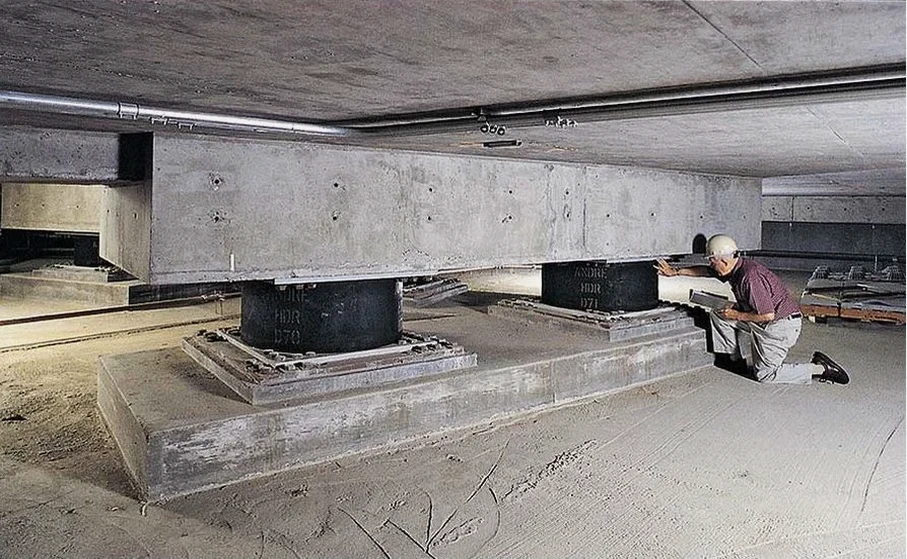
The Sumas till underlying much of Abbotsford is a dense, overconsolidated glacial deposit that can look bombproof on a borehole log, but in a subduction-zone earthquake it transmits short-period energy straight into a conventional fixed-base structure. Abbotsford sits within the Georgia Basin seismic source zone, and the NBCC 2020 uniform hazard spectra for this area show significant spectral acceleration in the 0.2 s to 1.0 s range — exactly where mid-rise concrete and steel frames live. When we design base isolation for an Abbotsford project, we start with a site-specific response spectrum and then tune the isolator properties so the fundamental period of the isolated structure shifts well past the dominant ground-motion period, typically into the 2.5 s to 3.5 s range. For sites where deep soft clay overlies till, seismic microzonation helps us map basin-edge effects before we commit to an isolation system.
A well-tuned base isolation system can cut seismic base shear by 60–70 %, turning a code-level design earthquake into a serviceability event for the superstructure.
Common questions
Does base isolation make sense for a four-storey wood-frame building in Abbotsford?
Usually not — the added cost of the isolation plane, moat, and flexible utility connections is hard to justify for a low-rise wood structure that already has high ductility. Isolation becomes cost-effective around six storeys and up, or for essential facilities (hospitals, data centres) where operational continuity after a design-level earthquake is non-negotiable.
How much does base isolation design cost for a typical Abbotsford project?
Engineering fees for a full isolation design — including site-specific hazard analysis, isolator selection, nonlinear time-history modelling, and construction-phase testing oversight — usually run between CA$5,460 and CA$12,520 depending on building complexity and the number of ground-motion records required. Prototype testing of the isolators is a separate cost handled directly between the owner and the test laboratory.
What ground-motion records do you use for Abbotsford sites?
We pull from the PEER NGA-West2 database, selecting records that match the NBCC 2020 target spectrum for the site class and the deaggregated magnitude-distance pair for the Georgia Basin and crustal sources. For near-fault sites we include pulse-type records from events like Chi-Chi and Northridge, scaled to the project’s MCE level.
How do you handle the high water table in Abbotsford for below-grade isolation interfaces?
The isolation plane is typically raised above the finished basement slab, with a drained and waterproofed moat that connects to a sub-slab perimeter drain and sump. We specify marine-grade stainless steel for all embedded isolator components and require a continuous waterproofing membrane lapped over the moat wall and isolator pedestals, tested with flood-testing before the isolators are installed.