← Home · Ground improvement

Stone Column Design in Abbotsford: Ground Improvement for Fraser Valley Soils

Together, we solve the challenges of tomorrow.

LEARN MORE →

The Fraser Valley doesn't forgive weak ground. Abbotsford sits on a deep sequence of post-glacial silts and soft Sumas clays that compress under load and amplify seismic motion. Standard footings often fail here. Stone column design changes that equation. Vertical columns of compacted gravel replace the soft matrix, stiffening the profile and accelerating drainage. The 2021 atmospheric river event showed how quickly saturated silts lose bearing capacity across the Abbotsford flats. A properly dimensioned grid of stone columns provides both settlement control and a drainage path that shortens consolidation time from months to weeks. We combine CPT data with lab consolidation curves to size the columns. Diameter, spacing, and depth depend on the undrained shear strength profile. For liquefiable layers below the Sumas aquitard, we integrate liquefaction assessment parameters directly into the column design.

A stone column grid can cut primary consolidation settlement by 60 percent and reduce post-seismic reconsolidation time from years to under three months.

Process and scope

The 2020 edition of the NBCC places Abbotsford in seismic category D with site class ranging from C to E depending on location. On class E profiles over 15 m thick, stone columns do double duty: settlement reduction plus liquefaction mitigation. A typical grid uses 0.8 to 1.2 m diameter columns spaced at 1.8 to 3.0 m centers, installed by bottom-feed vibrator. The vibro-replacement process densifies the surrounding soil laterally. We verify performance with post-installation CPT testing at centroid locations between columns. When the project footprint extends onto Sumas Mountain colluvium, we often pair stone columns with slope stability analysis to check global failure modes under the improved ground. Column length is terminated in a competent bearing layer, usually the advance outwash deposits at 12 to 20 m depth in central Abbotsford. Our lab runs grain size distribution on the imported stone per ASTM D448 to confirm permeability contrast with the native silt.
Stone Column Design in Abbotsford: Ground Improvement for Fraser Valley Soils
Technical reference image — Abbotsford

Local ground factors

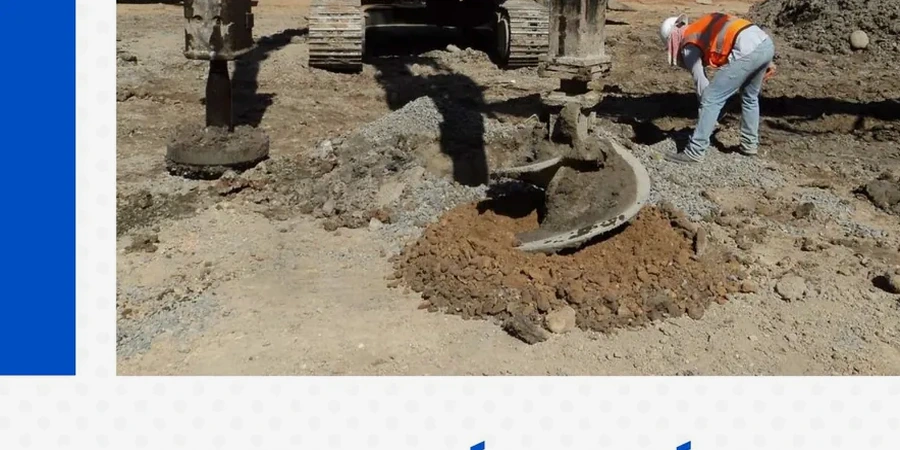
The bottom-feed vibrator rig weighs over 40 tonnes and exerts a centrifugal force exceeding 300 kN. In Abbotsford's silty clays, the probe advances under its own weight plus water flush through the tip. The critical moment happens at the design depth. Stone is fed through the hopper and compacted in 0.6 m lifts as the vibrator is extracted. If extraction speed exceeds 0.3 m per minute, column continuity breaks. We monitor amperage draw on the hydraulic motor in real time. A spike means dense surrounding soil; a drop signals a neck or collapse. On sites east of Sumas Way where organic lenses appear at 4 to 6 m, the operator must hold the vibrator longer at each lift to force stone radially into the peat seam. Winter installations between November and February require heated stone stockpiles to prevent ice bonding during placement.

Need a geotechnical assessment?

Reply within 24h.

Email: contact@geotechnicalengineering.xyz

Video overview

Reference parameters

ParameterTypical value
Typical column diameter0.8 to 1.2 m
Grid spacing range1.8 to 3.0 m (center to center)
Depth to bearing layer12 to 20 m (central Abbotsford)
Stone gradationASTM D448 No. 57 or No. 6
Post-installation verificationCPT at centroid + zone load test
Settlement reduction factorn = 2.5 to 4.0 (area ratio dependent)

Complementary services

01

Pre-design site investigation

CPT soundings and Shelby tube sampling to map undrained shear strength and layer thickness across the building footprint.

02

Column grid dimensioning

Calculation of diameter, spacing, and depth using Priebe method and 3D finite element models calibrated to Abbotsford clay parameters.

03

Liquefaction mitigation design

Stone column arrays sized to limit excess pore pressure ratio below 0.6 under the 1-in-475-year seismic event.

04

Post-installation verification

Zone load tests and CPT profiling between columns to confirm achieved stiffness and drainage performance.

Regulatory framework

NBCC 2020 (seismic site class and foundation provisions), ASTM D448-12 (standard classification for sizes of aggregate), CSA A23.3-19 (design of concrete structures, referenced for column caps), ASTM D5778-20 (CPT for post-installation verification)

Common questions

What does stone column design cost for a typical Abbotsford warehouse site?

For a medium-scale commercial building on compressible Sumas clay, stone column design and installation typically ranges from CA$2,100 to CA$7,550 depending on treated area, column depth, and grid density. The design fee portion covers CPT interpretation, Priebe calculations, and construction specifications.

How do stone columns perform during a Fraser River flood event?

They perform well because the gravel columns act as vertical drains. During the November 2021 atmospheric river, sites with stone columns in Abbotsford drained excess pore pressure faster than untreated ground. The key is maintaining a free-draining blanket layer at the surface connected to the site stormwater system.

What depth of soft soil justifies stone columns instead of surcharge preloading alone?

When the compressible layer exceeds 6 m thickness and the project schedule cannot accommodate 12 to 18 months of surcharge with wick drains, stone columns become the practical choice. They provide immediate stiffness gain and shorten post-construction settlement to weeks rather than months.
Location and service area

We serve projects in Abbotsford and surrounding areas.

View larger map