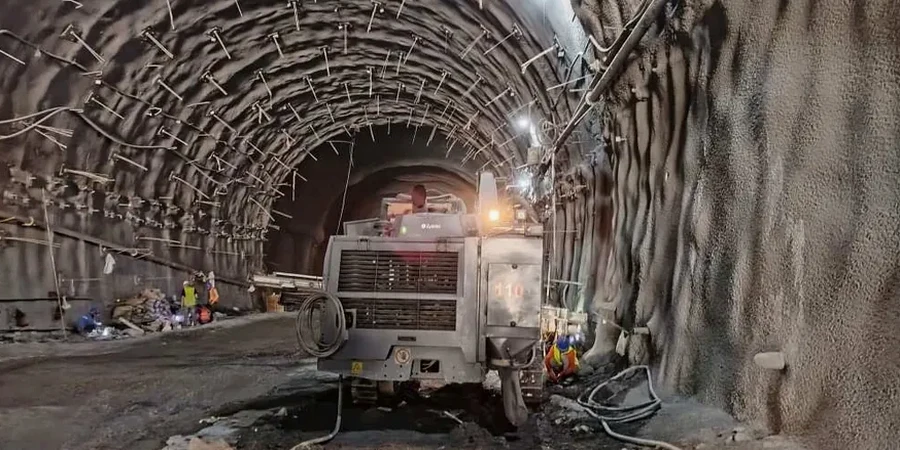
Abbotsford sits on a complex mix of Sumas Drift and Advance glacial deposits, where stiff clay tills can transition into loose outwash sand within a single cut. That variability, combined with a water table that often sits just 3 to 5 meters below grade across the Matsqui Prairie, makes unmonitored excavation a direct gamble. Our team deploys automated inclinometers, vibrating wire piezometers, and robotic total stations to track shoring deflection and pore pressure in real time. For deep excavations near the Sumas fault zone, we pair monitoring with a seismic refraction survey to map bedrock depth before the first bucket hits the ground, because the difference between till and weathered mudstone changes the entire support design.
Real-time deflection data turns a shoring design from a static calculation into a living safety system that adapts to what the ground actually does.
Common questions
How much does geotechnical excavation monitoring cost for a typical Abbotsford project?
Monitoring programs in Abbotsford typically range from CA$1,000 to CA$3,140 per month depending on the number of instruments, reading frequency, and whether automated data loggers are required. A basic manual program with four inclinometer readings and two piezometer checks per month starts lower, while a fully automated system with robotic total station, cloud dashboard, and 24/7 alerting sits at the upper end.
What instrumentation do you install for a deep excavation in glacial till?
We install vertical inclinometer casings in boreholes behind the shoring wall, typically extending 3 to 5 meters below the subgrade elevation to capture any deep-seated movement. Vibrating wire piezometers are placed at the mid-height of the retained soil and at the base of the excavation to monitor pore pressure changes. Optical survey prisms are fixed to the walers, the adjacent street pavement, and any building within the zone of influence.
How quickly can you deploy a monitoring system after we start excavation?
Inclinometer casing and piezometers require boreholes drilled before or during the early excavation stages, ideally from the working grade before the cut reaches 3 meters. We can mobilize a drill rig and install instruments within 3 to 5 working days of receiving a notice to proceed. Optical survey prisms and baseline readings can be established in a single day once the shoring wall is in place.
Do you provide monitoring data that the City of Abbotsford building inspector will accept?
Yes. All reports are stamped by a professional engineer registered with Engineers and Geoscientists BC and reference the NBCC 2020 and CSA A23.3 standards. We present deflection versus time plots, pore pressure hydrographs, and cumulative displacement vectors in a format that municipal inspectors and the geotechnical engineer of record can review directly without reformatting.