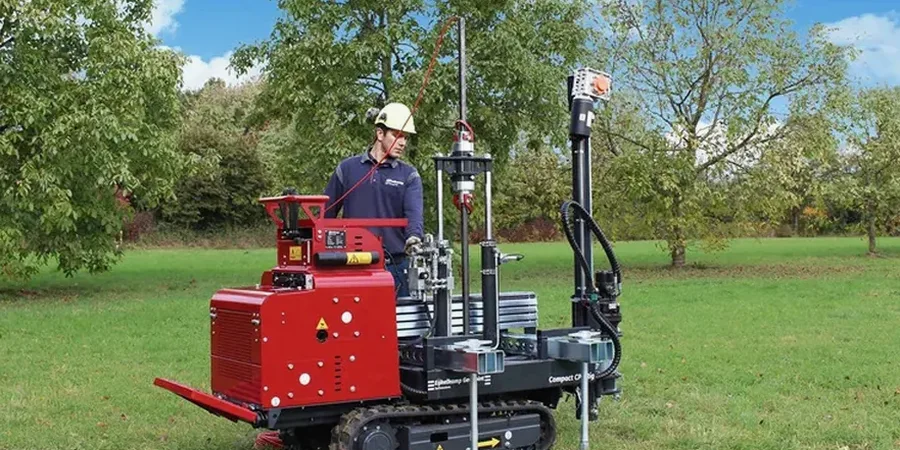
Abbotsford’s geological story is shaped by ancient glacial lakes and the Fraser River floodplain. The Sumas Prairie, once a lakebed, left behind deep deposits of soft silts and clays that challenge any construction project. A standard borehole can miss crucial thin layers, but a cone penetration test reads the soil continuously. In a city where a 3-story commercial building can sit on 25 meters of compressible sediment, understanding the stratigraphy without gaps matters. Our CPT rigs push through these cohesive soils at a constant rate, measuring tip resistance and sleeve friction every centimeter. The data stream feeds directly into foundation design, whether the site is near McCallum Road or out toward Bradner. When the cone encounters a dense lens of Sumas Drift, the real-time readings show it instantly. For projects requiring ground improvement verification, stone column installations often rely on CPT profiles to confirm densification depth.
A CPT profile in Abbotsford's Sumas sediments reveals stratigraphy that standard boreholes routinely miss—continuous data changes the foundation conversation.
Process and scope
A 6-story mixed-use structure on South Fraser Way presented a common Abbotsford problem: soft silts interbedded with unpredictable sand layers. Standard SPT sampling at 1.5-meter intervals would have averaged out the thin, potentially liquefiable seams. The CPT cone, pushed at 2 cm per second, generated a nearly uninterrupted profile of the upper 28 meters. Pore pressure dissipation tests at five discrete depths mapped the drainage characteristics of each unit. The friction ratio plot revealed a thin clay seam at 11 meters that the borelog had lumped into the silt layer above it. This changed the pile termination depth by 3 meters, saving the developer money. We see this scenario repeat across the Matsqui uplands, where glacial till is uneven and variable. The cone rig sets up in under 30 minutes on a standard city lot, and a full profile to 30 meters can be completed inside a morning, traffic permitting. Unlike drilling, there are no cuttings to dispose of. That simplifies logistics on tight urban sites.
Local ground factors
In the eastern sections of Abbotsford, near the foot of Sumas Mountain, alluvial fan deposits create a mix of cobbles and boulders within a silty matrix. A CPT cone can refuse on a large clast at 8 meters, leaving the lower profile unknown. Local experience tells us to pair the CPT with a single mud-rotary borehole in these transitional zones. The borehole clears the refusal question, and the CPT still provides the high-resolution data for the fine-grained units above and between obstructions. Another observation from the Sumas Prairie: the upper 3 meters of desiccated crust can read deceptively stiff. Designers who base shallow footing bearing capacity solely on the first few meters of CPT data risk underestimating the settlement in the soft, normally consolidated clay beneath. We flag this in every report. The pore pressure dissipation curves in these clays often take over 20 minutes to reach t50, a sign of low permeability that demands careful drainage planning.
Regulatory framework
ASTM D5778-20 (Standard Test Method for Electronic Friction Cone and Piezocone Penetration Testing of Soils), NBCC 2020 (National Building Code of Canada, geotechnical provisions), CSA A23.3:19 (Design of Concrete Structures, foundation references), ISO 17025:2017 (General requirements for the competence of testing and calibration laboratories)
Common questions
How deep can a CPT go in Abbotsford's typical soils?
In the soft silts and clays of the Sumas Prairie, we routinely reach 30 to 35 meters with a 20-ton rig. In areas with dense glacial till or near Sumas Mountain, refusal may occur shallower if cobbles or boulders are encountered. We assess site geology before mobilizing to set realistic depth expectations.
What does CPT testing cost per meter in Abbotsford?
CPT profiling in Abbotsford typically ranges from CA$250 to CA$290 per meter, depending on total depth, site access, and whether pore pressure dissipation tests are included. A standard 25-meter profile with five dissipation tests falls within this range. We provide a firm quote after reviewing the site location and project scope.
Do you need to drill a borehole before running a CPT?
No pre-drilling is required for the CPT itself. The cone pushes directly from the ground surface. However, on sites with known fill, asphalt, or gravel lenses in the upper meter, we may use a small pre-auger to avoid cone damage. This takes about 15 minutes and is included in our mobilization.
How quickly do you deliver the CPT report?
Raw data is available the same day. The final interpreted report, including soil behavior type classification, corrected cone resistance, and liquefaction analysis if requested, is typically delivered within three business days. We can expedite for time-sensitive projects.