← Home · Slopes & Walls

Retaining Wall Design in Abbotsford – Geotechnical Engineering for Fraser Valley Slopes

Together, we solve the challenges of tomorrow.

LEARN MORE →

The National Building Code of Canada sets clear rules for earth retention, and in Abbotsford those rules hit different. The city sits on a series of glacial till benches that step down toward the Fraser River, with Sumas Mountain clay colluvium blanketing the lower slopes. A retaining wall here is not a catalogue pick. We design for the specific soil unit on your lot—whether it is the compact Vashon till near McKee Peak or the soft post-glacial silts east of Highway 11. Before we size a stem or calculate heel width, we verify the stratigraphy because the difference between a 6-foot and a 9-foot embedment can be two metres of saturated clay nobody spotted. That upfront investigation is cheaper than a leaned wall, and it is the only way to get a permit through City Hall on the first submission.

A retaining wall in Abbotsford is a drainage structure first and a structural element second—get the water wrong and no amount of steel fixes it.

Process and scope

The wet-coast climate forces a different design logic than what works in the Interior. Abbotsford gets over 1,500 millimetres of rain annually and the November 2021 atmospheric river dropped a month of water in two days—events that turn silt seams into slip planes overnight. We specify free-draining backfill, continuous footing drains, and weep-hole schedules that assume the drain will be half-plugged within five years because that is what field reality looks like. For walls over four feet we run bearing capacity and global stability checks that account for the perched water table that forms above the glacial till contact—a condition we have measured repeatedly with standpipe piezometers on the Matsqui bench. When the site includes a cut into Sumas clay, we often pair the wall design with a slope stability analysis to confirm the temporary excavation face holds during construction, because a surficial slide in that material can mobilize faster than a crew can react.
Retaining Wall Design in Abbotsford – Geotechnical Engineering for Fraser Valley Slopes
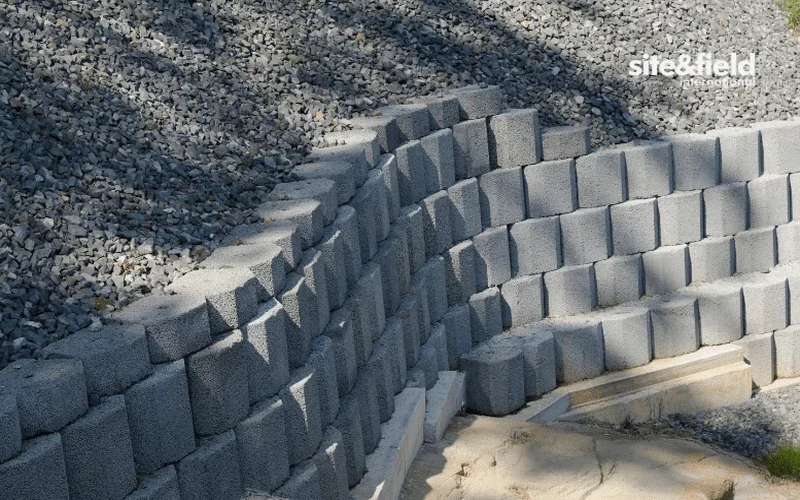
Technical reference image — Abbotsford

Local ground factors

Abbotsford expanded fast after the 1990s, pushing subdivisions onto the lower Sumas benches and up against the mountain foothills—ground that earlier farmers left as bush because it was too wet or too steep to plow. That development history means half the retaining walls we review today are replacing failed timber crib walls that were built without an engineered footing drain in soil that holds water like a sponge. The real risk is not the wall failing under its own load. It is the uphill neighbour's pool deck surcharge, or the city storm main that leaks 40 litres an hour into the backfill zone, or the clay lens at two metres depth that nobody cored because the client wanted to save CA$800 on a drill hole. Those are the scenarios where a wall leans five degrees in one rainy season and the repair bill is triple the original construction cost. Our scope defines the investigation depth and the drainage detail to the point where the contractor cannot value-engineer them out.

Need a geotechnical assessment?

Reply within 24h.

Email: contact@geotechnicalengineering.xyz

Reference parameters

ParameterTypical value
Minimum embedment depth (cut walls, H < 3m)0.6 m or frost depth, whichever governs
Backfill specification (granular)ASTM D2488 well-graded sand-gravel, < 5% fines
Foundation soil bearing capacityFactored resistance per NBCC geotechnical report, typically 150-250 kPa for Vashon till
Seismic coefficient kh (NBCC 2020)0.15-0.25 for Site Class C/D, Abbotsford location
Weep-hole spacing (min.)1.5 m o.c., 100 mm Ø, with geotextile filter sock
Global factor of safety (static)≥ 1.5 (sliding), ≥ 2.0 (overturning)
Backfill compaction spec95% SPMDD per ASTM D698 within 1 m of wall stem
Surcharge load assumption12 kPa minimum live load unless traffic barrier present

Complementary services

01

Cantilever and Gravity Wall Engineering

Full structural-geotechnical design of reinforced concrete cantilever walls, segmental block walls, and mass gravity walls. Deliverables include factored bearing pressures, stem and heel reinforcement schedules, global stability output files, and a sealed construction drawing set ready for permit submission.

02

Drainage and Groundwater Control Design

Design of the wall drainage system as a standalone deliverable: continuous footing drain sizing, weep-hole layout, chimney drain specification, and surface water diversion swales. We include monitoring recommendations for walls that intercept the seasonal perched water table common on the Sumas benches.

Regulatory framework

NBCC 2020 Part 4, CSA A23.3:19 (Design of concrete structures), ASTM D1586 (Standard Penetration Test), ASTM D698 (Standard Proctor)

Common questions

How much does a retaining wall design cost in Abbotsford?

Design fees for a typical residential retaining wall in Abbotsford range from CA$1,620 to CA$4,910 depending on wall height, site access, and the investigation work needed. A 4-foot segmental block wall on a flat lot sits at the lower end; an 8-foot reinforced concrete wall on a sloping site with poor soil and a required borehole sits at the upper end. The fee covers the geotechnical investigation, structural calculations, drainage design, and the sealed drawing set for the building permit.

Does the City of Abbotsford require a geotechnical report for a retaining wall?

Yes. The City's building permit review triggers a geotechnical report requirement for any retaining wall over 1.2 metres in height, or any wall supporting a surcharge such as a driveway or building. The report must be sealed by a professional engineer licensed in British Columbia and must address bearing capacity, global stability, seismic design, and drainage.

What soil conditions in Abbotsford cause the most retaining wall problems?

The two biggest problems are the Sumas clay colluvium on the lower mountain slopes, which loses strength dramatically when saturated, and the perched groundwater that sits above the Vashon till contact at roughly 1.5 to 3 metres depth. Both conditions create high lateral earth pressures and reduce sliding resistance. A design that ignores either one will show distress within the first two wet seasons.

Do you handle the construction inspection as well?

Yes. We provide part-time field review during construction to verify that the foundation subgrade matches the design assumptions, that the backfill material and compaction meet the specification, and that the drainage components are installed correctly. The field review report becomes part of the final permit close-out documentation required by the City.
Location and service area

We serve projects in Abbotsford and surrounding areas. More info.

View larger map