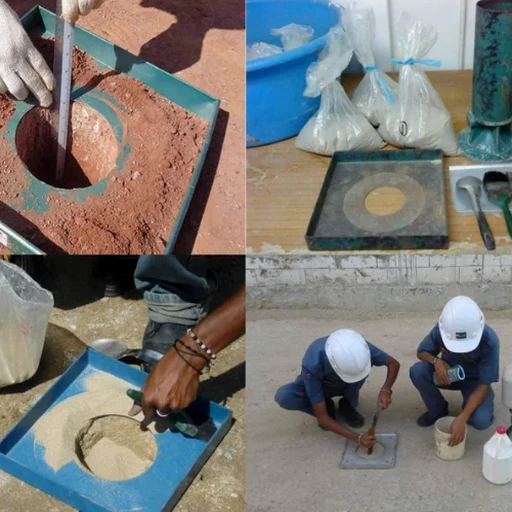
A warehouse slab on Sumas Way started showing hairline cracks six months after handover. The contractor had compaction tickets from the grader, but no third-party density verification on the structural fill. That single omission triggered a $140,000 remedial grouting program. In Abbotsford’s glacial till and Sumas clay deposits, achieving 95% Modified Proctor isn’t a paperwork exercise — it’s the difference between a floor that stays flat and one that settles unevenly under forklift traffic. The sand cone density test remains the direct, destructive reference method for compaction verification, and it’s the one municipal inspectors and geotechnical engineers trust when reviewing foundation subgrade, utility trench backfill, and roadway base course. We run the procedure on active construction sites across the Fraser Valley, from the airport industrial zone to residential subdivisions backing onto Matsqui Trail, always with the same principle: if the test pit isn’t excavated carefully and the sand isn’t calibrated to the site-specific gradation, the number on the report means nothing.
A 1% shift in compaction ratio on a 2-metre structural fill can reduce bearing capacity by 15% — the sand cone test catches what a proof roll misses.
Process and scope
The field kit we mobilize to Abbotsford sites is built around a 12-inch density plate, a pre-weighed one-gallon sand jug, and a precision balance readable to 1 gram. The sand itself — 20-30 Ottawa sand — comes from a single batch calibrated at our lab against the site’s own base material. Why does single-batch calibration matter? Because the bulk density of sand shifts with moisture and handling, and a 2% error in cone correction factor translates to a compaction ratio that can pass or fail a lift. We excavate the test hole to the full lift thickness, typically 8 to 12 inches for structural fill, and recover every gram of soil for moisture content determination. The cone correction is verified on site before the first test and after every ten holes; in wet weather, we re-verify more often. For granular sub-base under
flexible pavement on arterial roads like Maclure Road, we correlate sand cone results with nuclear gauge readings to build a site-specific calibration curve, which lets the paving crew run rapid density checks without sacrificing accuracy. When the fill contains cobbles or oversized particles, we apply the rock correction procedure from ASTM D4718, adjusting the maximum dry density before computing the compaction percentage — a step that many quick-turnaround field services skip, and one that completely changes the pass/fail call on Fraser River alluvial deposits.
Local ground factors
Abbotsford sits at roughly 38 metres above sea level on a mix of glacially overridden Sumas clay, post-glacial alluvium along the Fraser and Sumas rivers, and compact till at higher elevations toward the Matsqui uplands. The clay can hold moisture through July, and a fill placed at 2% above optimum in the morning can be 4% over by noon if the sun breaks through — the proctor curve shifts, and a density test that passed at 10 a.m. fails at 2 p.m. with the same compactive effort. Liquefaction susceptibility in the Sumas Prairie area, documented in the City’s Official Community Plan hazard mapping, means that backfill around deep utilities and foundation subgrades must meet density targets without exception; loose granular fill in a seismic event can lose strength rapidly. We’ve seen trench reinstatements on South Fraser Way settle 50 mm in the first rainy season because the contractor compacted in lifts too thick for the hammer size and nobody verified in-place density at mid-depth. When compaction control fails, the fix is never cheap: it’s undercut, re-compact, and re-test, often with stone columns or vibrocompaction as a contingency if the loose zone extends below the footing influence depth.
Regulatory framework
ASTM D1556-15e1 — Standard Test Method for Density and Unit Weight of Soil in Place by the Sand-Cone Method, ASTM D1557-12e1 — Standard Test Methods for Laboratory Compaction Characteristics of Soil Using Modified Effort, ASTM D4718-87(2007) — Standard Practice for Correction of Unit Weight and Water Content for Soils Containing Oversize Particles, AASHTO T-191-20 — Density of Soil In-Place by the Sand-Cone Method, NBC 2015 — National Building Code of Canada, Part 4: Structural Design, CSA A23.3-14 — Design of Concrete Structures (referenced for foundation subgrade acceptance)
Common questions
What does a field density test with the sand cone method cost in Abbotsford?
Budget between CA$160 and CA$170 per test for a standard structural fill or trench backfill density check, assuming a minimum of four tests per mobilization within the Abbotsford area. The unit rate includes the sand cone apparatus, calibrated sand, moisture content determination, and the signed field report. Sites requiring rock correction or correlation with nuclear gauge readings may carry a small surcharge per test.
How does the City of Abbotsford handle compaction test requirements?
The City’s Engineering Department reviews compaction test reports as part of subdivision and servicing agreement close-out. They expect third-party testing by a qualified geotechnical lab, documentation at the frequencies specified in the approved earthworks specification, and clear traceability from each test location to the laboratory proctor curve. Failing tests must be documented along with the remediation method and re-test results.
Can one sand cone test represent a full day’s fill placement?
No. A single test represents the density of the lift at one station and offset. Material variability, changes in moisture, and roller coverage gaps mean that one passing result does not guarantee uniform compaction across the pad. The standard frequency — one test per 300 m² per lift — is a minimum; we often tighten spacing when the fill source changes or when visual inspection suggests variable compaction.
What’s the biggest source of error in sand cone testing?
The cone correction factor drifting during the day. Sand bulk density changes with vibration during transport, moisture absorption from humid air, and segregation in the jug. If the technician doesn’t re-verify the cone correction on site after every ten holes — and more often in wet conditions — the calculated in-place density can drift by 1–2%, which is enough to flip a pass/fail decision on a 95% Modified Proctor specification.