← Home · Laboratory

Atterberg Limits Testing & Soil Plasticity Analysis in Abbotsford

Together, we solve the challenges of tomorrow.

LEARN MORE →

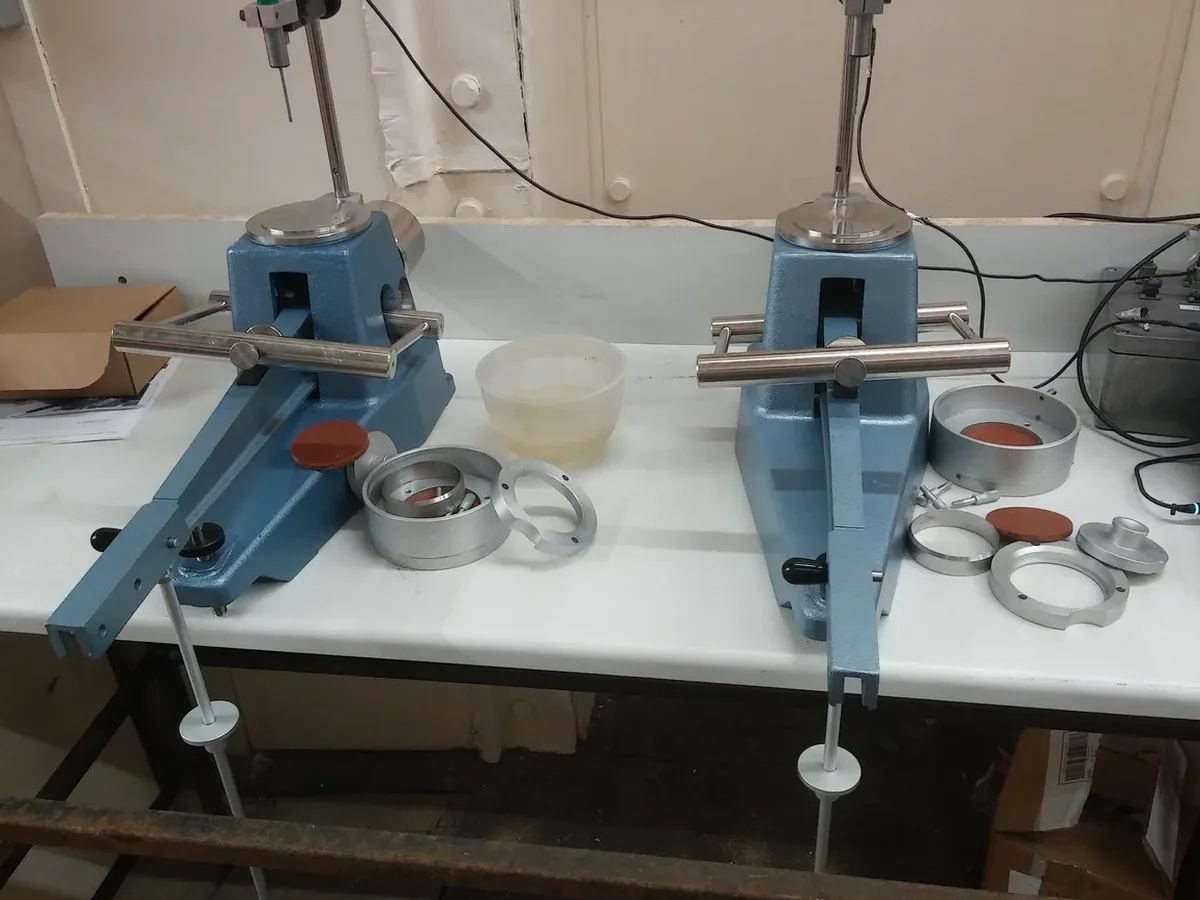
The Casagrande cup sits on a level bench in the Abbotsford lab, its brass bowl ready to drop 10 mm onto a hard rubber base at precisely two blows per second. This is the mechanical heart of the liquid limit test, a procedure that defines how much water a Fraser Valley silty clay can hold before it flows. In a city where Sumas Prairie lacustrine deposits dominate the subsurface, the groove closure test tells a story that standard penetration numbers alone cannot. When the technician rolls out 3 mm threads for the plastic limit, the crumbling point of each thread reveals the boundary between semi-solid and plastic behavior. These two numbers frame everything from shallow footing bearing capacity to seasonal shrink-swell risk in the agricultural fringes east of Highway 11. We run the full procedure under ASTM D4318-17e1, with oven-dried material passing the No. 40 sieve, and report results that feed directly into USCS classification and foundation design parameters for projects across the Matsqui lowlands.

Liquid limit at 25 blows is not an arbitrary number. It is the moisture content where a clay loses its shear strength and becomes a viscous fluid. In Abbotsford, that threshold governs excavation safety.

Process and scope

ASTM D4318 methodology carries particular weight in Abbotsford because the local glacial and post-glacial stratigraphy produces fines that plot right on the A-line of the Casagrande plasticity chart. A one-percent shift in liquid limit can flip a soil from CL to MH, changing allowable bearing assumptions. Our wet preparation method starts with material soaked in distilled water for a minimum of 16 hours, which prevents the hydration lag that skews results in smectitic clays common near the Sumas River floodplain. We run five-point liquid limit determinations rather than the one-point shortcut, computing the flow curve by least-squares regression and reporting the liquid limit at 25 blows with a correlation coefficient above 0.990. For the plastic limit, three replicate threads per sample ensure the mean value reflects true material behavior, not operator variability. These data feed directly into triaxial shear strength modeling where effective stress parameters depend on accurate plasticity classification, and into slope stability analyses for the hillside developments pushing up the western edge of Abbotsford toward the Sumas Mountain escarpment.
Atterberg Limits Testing & Soil Plasticity Analysis in Abbotsford
Technical reference image — Abbotsford

Local ground factors

Abbotsford sits at roughly 38 meters elevation on the Fraser River floodplain, with Sumas Prairie occupying a former lakebed drained in the 1920s. The November 2021 atmospheric river event demonstrated what happens when these low-lying clay soils reach saturation: broad-scale inundation that persisted for weeks. Atterberg limits become a direct risk management tool in this context. A soil with a liquidity index approaching 1.0 is already at its liquid limit in-situ; any additional moisture from rain or irrigation pushes it past the threshold where bearing capacity collapses. Foundation pads poured on high-PI clays without moisture conditioning can heave three to five centimeters during wet winters and shrink during dry summers, cracking slab-on-grade construction throughout the Clearbrook area. By quantifying the exact plastic range of the formation, we help structural engineers specify moisture-conditioned subgrades or select deep foundation alternatives that bypass the active zone entirely. The modest cost of a plasticity suite is measured against the six-figure remediation expense of underpinning a settled structure.

Need a geotechnical assessment?

Reply within 24h.

Email: contact@geotechnicalengineering.xyz

Reference parameters

ParameterTypical value
Liquid Limit (LL)Determined via Casagrande cup, 5-point flow curve, reported at 25 blows per ASTM D4318-17e1
Plastic Limit (PL)3 mm thread rolling method, mean of three replicate determinations, oven-dried basis
Plasticity Index (PI)PI = LL - PL, classifying soil plasticity from non-plastic (PI < 1) to highly plastic (PI > 40)
Liquidity Index (LI)Computed from in-situ moisture content, indicating whether soil is brittle, plastic, or liquid in its natural state
Activity (A)PI divided by clay fraction (< 2 µm), identifying swelling potential in Abbotsford smectitic deposits
USCS ClassificationCL, CH, MH, ML, or OL based on plasticity chart position relative to A-line and U-line
Sample PreparationWet method with 16-hour minimum distilled water soaking, material passing No. 40 (425 µm) sieve
Reporting FormatFull curve plot with regression equation, R-squared value, and individual data point coordinates

Complementary services

01

Full Atterberg Limits Suite (LL + PL + PI)

Complete five-point liquid limit determination with Casagrande cup, three-point plastic limit by thread rolling, and computed plasticity index. Includes USCS classification, liquidity index calculation from field moisture content, and activity analysis for swelling potential assessment. Delivered with flow curve plot and regression statistics. Turnaround typically 3-4 working days from sample receipt.

02

Soil Classification Package (Atterberg + Grain Size)

Combined plasticity testing and hydrometer analysis for full particle-size distribution, enabling dual USCS and AASHTO classification. Ideal for Abbotsford sites with transitional silty-clayey profiles where both Atterberg limits and sand-silt-clay fractions govern engineering behavior. Includes unified boring log integration and foundation parameter recommendations.

Regulatory framework

ASTM D4318-17e1: Standard Test Methods for Liquid Limit, Plastic Limit, and Plasticity Index of Soils, ASTM D2487-17: Standard Practice for Classification of Soils for Engineering Purposes (Unified Soil Classification System), CSA A23.3-19: Design of Concrete Structures (subgrade modulus assumptions tied to soil classification), NBCC 2020: National Building Code of Canada, Section 4.2 (foundation design requiring soil classification data)

Common questions

How much do the Atterberg limits tests cost in Abbotsford?

A full Atterberg limits suite (liquid limit, plastic limit, and plasticity index) in the Abbotsford area typically ranges from CA$90 to CA$150, depending on the number of samples and whether it is bundled with grain size analysis. The combined classification package provides better value when both plasticity and particle-size data are required for USCS designation.

What is the difference between the one-point and multi-point liquid limit method?

The one-point method uses a single determination and an empirical correction factor to estimate the liquid limit at 25 blows. The multi-point method ASTM D4318 requires a minimum of three, and ideally five, determinations at varying blow counts, with a flow curve fitted by least-squares regression. Multi-point results are more reliable in the variable lacustrine clays found across Abbotsford, where small changes in moisture content produce large changes in blow count.

How long does Atterberg testing take from sample submission to report?

Standard turnaround is three to four working days. The wet preparation method requires a minimum 16-hour soaking period before testing can begin, and oven-drying for moisture content determination adds additional time. Rush processing can deliver results in 48 hours when project schedules demand it.

Which soils in Abbotsford require Atterberg testing?

Any fine-grained soil with more than 50 percent passing the No. 200 (75 µm) sieve should be tested. In Abbotsford, this includes the Sumas Prairie lacustrine silts and clays, the glacial till-derived clays on the upland slopes, and the alluvial deposits along the Fraser River. The test is particularly important where the plasticity chart shows soils plotting near the A-line, where the CL versus MH distinction has significant foundation design implications.
Location and service area

We serve projects in Abbotsford and surrounding areas.

View larger map