← Home · Geophysics

Seismic Tomography (Refraction/Reflection) for Subsurface Imaging in Abbotsford

Together, we solve the challenges of tomorrow.

LEARN MORE →

One of the costliest mistakes we encounter on Abbotsford sites is assuming uniform bedrock depth across a building footprint. The glacial and fluvial deposits that blanket the Fraser Valley can hide abrupt changes in bedrock topography, buried channels, or compressible organic lenses that a handful of boreholes simply miss. Seismic tomography, both refraction and reflection, maps these transitions continuously along survey lines, giving you a cross-sectional view of the subsurface rather than isolated point data. When a warehouse foundation on Sumas Way settles differentially because one corner sits on 12 meters of soft clay and the other hits bedrock at 4 meters, the repair bill far exceeds the cost of a pre-construction tomographic survey. Our field crew deploys 24- or 48-channel seismographs with geophone spacings tuned to the target depth, and we process the data with first-arrival traveltime inversion for refraction sections and CMP stacking for reflection profiles.

A seismic tomography line costs a fraction of a single deep borehole and delivers continuous subsurface information that no drill rig can match.

Process and scope

Abbotsford’s location at the foot of Sumas Mountain and its history of catastrophic flooding, including the great flood of 1890, mean that near-surface materials range from coarse alluvial fan gravels to lacustrine silts and clays that can be underconsolidated. This stratigraphic complexity makes seismic velocity contrasts sharp but unpredictable, which is why we calibrate every tomography line with at least one borehole or test pit log to tie seismic boundaries to actual lithology. Refraction surveys work best for mapping bedrock depth and rippability up to about 30 meters when velocity increases with depth, while high-resolution reflection can image finer layering, groundwater tables, and even fault offsets within the unconsolidated cover. We typically source with a 10-kg sledgehammer on a steel plate for shallow targets or switch to a weight-drop system when we need energy penetration beyond 40 meters in saturated silts. Processing includes static corrections for elevation changes, which matter a great deal on the sloped sites common in the Bradner and Matsqui areas.
Seismic Tomography (Refraction/Reflection) for Subsurface Imaging in Abbotsford
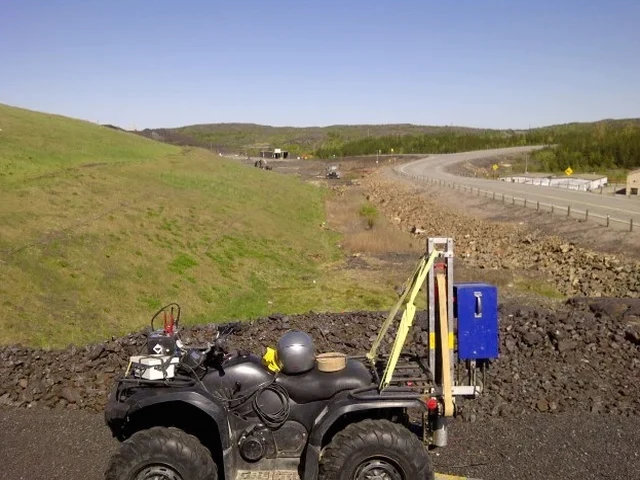
Technical reference image — Abbotsford

Local ground factors

On the Sumas Prairie side of town, we have often seen seismic refraction surveys misinterpreted when a hidden low-velocity layer, such as a saturated peat pocket beneath a gravel cap, goes undetected because first arrivals travel through the faster overlying material. This blind zone can mask a compressible layer that later causes differential settlement under embankment loads. We mitigate this by running a reflection profile over the same line whenever the site stratigraphy suggests possible velocity inversions, and by integrating MASW surface-wave data to capture the low-velocity interval independently. Another local hazard is the seismic site classification for the National Building Code; a site that appears to be class C based on sparse SPT data can easily prove to be class D or E once the average shear-wave velocity is mapped across the full footprint with a tomographic approach.

Need a geotechnical assessment?

Reply within 24h.

Email: contact@geotechnicalengineering.xyz

Reference parameters

ParameterTypical value
Survey depth range (refraction)5 to 40 m typical, up to 80 m with weight drop
Geophone array24 or 48 channels, spacing 2 to 10 m
Seismic sourcesSledgehammer, weight drop, or accelerated weight drop
P-wave velocity resolutionTypically 5-10% after tomographic inversion
Line length per day200 to 400 m depending on terrain and source type
Applicable standardASTM D5777 for seismic refraction
Output deliverables2D velocity sections, depth-to-bedrock maps, rippability classification

Complementary services

01

Seismic Refraction Tomography

P-wave refraction profiling to map bedrock topography, assess rippability for excavation planning, and determine the thickness of overburden. Typical line lengths of 115 to 230 meters with 24 geophones. We deliver 2D velocity cross-sections with interpreted geological boundaries tied to any available borehole control.

02

Seismic Reflection Profiling

High-resolution shallow reflection surveys for imaging stratigraphic layering, groundwater surfaces, and fault structures within the sediment column. We use single-channel or multi-channel arrays depending on resolution needs, with processing that includes deconvolution, NMO correction, and migration when the structure is complex.

Regulatory framework

ASTM D5777 Standard Guide for Using the Seismic Refraction Method, ASTM D7128 Standard Guide for Using the Seismic Reflection Method, NBCC 2020 – Seismic Site Classification (Vs30 and site class determination)

Common questions

How deep can seismic refraction see on a typical Abbotsford site?

Depth of investigation depends on the seismic source energy and the geophone spread length. With a sledgehammer on a 115-meter spread, we typically image down to 25–30 meters in the compact gravels and silts common around Abbotsford. Using a weight drop and longer spreads, we can reach 50–80 meters, enough to map bedrock across most of the Fraser Valley basin.

What is the cost of a seismic tomography survey for a standard commercial lot?

For a typical commercial lot in Abbotsford requiring a single refraction line of 115 to 230 meters with 24-channel acquisition, processing, and a final report with interpreted depth sections, the cost ranges from approximately CA$3,740 to CA$7,720 depending on line length, terrain difficulty, and whether reflection data is also acquired.

Can seismic tomography replace boreholes entirely?

No, and we never recommend it. Seismic methods give you excellent lateral continuity and velocity information, but they do not provide direct samples for laboratory testing. The best approach combines one or two strategically placed boreholes or test pits for lithological calibration with tomography lines that extend the interpretation across the entire site.

How does the local geology affect seismic data quality in Abbotsford?

The glacial till and outwash deposits that dominate Abbotsford generally transmit seismic energy well, producing clear first arrivals. The main challenge is the occasional presence of organic-rich lacustrine clays or peat layers that attenuate high frequencies. We compensate by using lower-frequency geophones and stronger source impacts when working in these soft sediments.

What are the access requirements for a seismic survey crew?

We need a cleared survey line roughly 1.5 meters wide along the full spread length, free of heavy brush and debris. The crew is typically two to three people with portable equipment. Steep slopes require extra time for setup, and active roadways or industrial noise can degrade data quality, so we often schedule acquisition during quieter periods.
Location and service area

We serve projects in Abbotsford and surrounding areas. More info.

View larger map