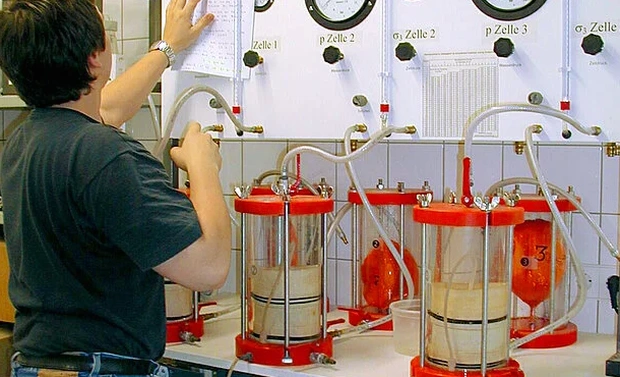
We still see pavement failures in Abbotsford where the subgrade looked fine during dry summer compaction but turned to mush after the first Fraser Valley rainy season. The culprit is almost always a soaked CBR value that was never measured. A simple field estimate does not cut it when you are dealing with the silty clays and glacial till that dominate the area east of Sumas Way. Our laboratory CBR test follows ASTM D1883 exactly, with a 96-hour soak to replicate the worst groundwater conditions you will face between Sumas Mountain and the Matsqui Prairie. Specimens are compacted at optimum moisture from a standard Proctor, then loaded with a piston at 1.27 mm/min until failure. The number you get is the real bearing capacity your pavement section needs, not a guess from a pocket penetrometer. For projects where the subgrade varies sharply, we often pair soaked CBR with a grain-size analysis to correlate fines content with strength loss, and Proctor compaction testing to confirm the density baseline before soaking begins.
A soaked CBR test is not a formality. In Abbotsford silts and tills, it is the difference between a pavement that lasts 20 years and one that fails in two.
Local ground factors
The soil profile between Clearbrook and the US border changes fast. Glacial till over clay, then sand lenses, then weathered bedrock. A single CBR value from one borehole can misrepresent the whole site. We saw this on a warehouse project near the airport where the design assumed CBR 8 across the truck yard. Boring 3 hit a wet silt pocket with soaked CBR 2.1. The pavement failed in 14 months. That repair cost more than the entire geotechnical budget. The risk compounds when the water table is high, which it is across much of Abbotsford from October through April. Swell pressure from clay layers adds another failure mode: the subgrade heaves unevenly, the asphalt cracks, water gets in, and the cycle accelerates. A soaked laboratory CBR test gives you the lower-bound strength, which is what you design for. Never design for the summer number. That is the most expensive shortcut you can take in the Fraser Valley.
Common questions
How much does a laboratory CBR test cost in Abbotsford?
A single-point soaked CBR test including the Proctor compaction curve runs between CA$160 and CA$300, depending on whether you need one point or three points. Three-point CBR with swell monitoring and full report is at the upper end of that range. We provide a fixed quote before you ship or drop off the sample so there are no surprises.
How long does it take to get results from a soaked CBR test?
The soak itself takes 96 hours, no way around that per ASTM D1883. After soaking, we need one day for penetration testing, data reduction, and report preparation. In practice, you will have the signed report in 5 to 7 business days from the day we receive the sample. Unsoaked CBR is faster, usually 3 business days.
Why does Abbotsford need soaked CBR instead of field CBR?
Field CBR tests, like those run with a dynamic cone penetrometer, are useful for compaction control during construction. But they do not replicate the long-term saturated condition that Abbotsford subgrades experience every winter. The high water table across the Sumas Prairie and the prolonged rainfall from November through March mean the subgrade will be soaked for months. Only a laboratory soaked CBR test, with a 96-hour immersion under a surcharge load, measures strength under those conditions. We recommend using the soaked lab value for pavement design and the field CBR for QA/QC verification during placement.