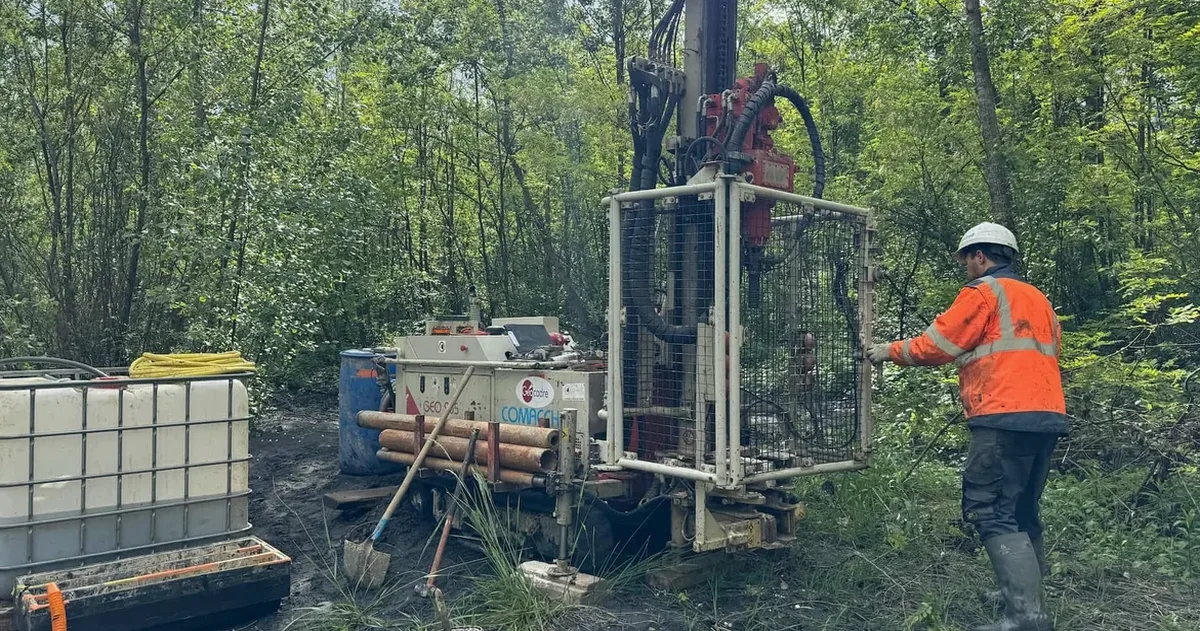
We have seen excavation failures in Abbotsford that started with a simple assumption: that the soil would hold. This city sits on a complex mix of glacial till, clay, and silty deposits from the Fraser River. You cannot copy a foundation design from Langley and drop it here. A proper soil mechanics study in Abbotsford must account for the Sumas Mountain landslide history and the compressible clays that run through the valley. Our team has pulled samples from sites along Highway 1 and near the Abbotsford International Airport where the bearing capacity varies by 40 percent in less than 50 meters. The NBCC 2020 requires site-specific data. We provide it. Before you break ground, we recommend pairing this study with a slope stability analysis if your site has any grade change at all — and in Abbotsford, most do.
Site class in Abbotsford can shift from C to E within a single block. Seismic demand doubles when that happens.
Process and scope
A 4-story mixed-use building on South Fraser Way. The developer assumed competent gravel at 2 meters. Our soil mechanics study in Abbotsford revealed 4.5 meters of soft organic silt before hitting anything structural. That changed the entire foundation strategy. We ran triaxial tests on undisturbed samples to get the real shear strength parameters. We measured consolidation rates to predict settlement over the 50-year design life. This is not a generic report. Each soil mechanics study in Abbotsford includes direct shear or triaxial testing, Atterberg limits, grain size distribution, and consolidation parameters when clays are present. We classify soils per the Unified Soil Classification System and assign site class per NBCC Table 4.1.8.4.A. The lab runs ASTM D4318 and ASTM D6913 as standard. For granular soils, we apply relative density correlations from SPT blow counts. The report gives you bearing capacity, settlement estimates, and lateral earth pressures — numbers you can hand directly to your structural engineer.
Common questions
What does a soil mechanics study in Abbotsford include?
It includes a site investigation with boreholes or test pits, soil sampling, laboratory testing for strength and consolidation, groundwater measurement, and an engineering report with bearing capacity, settlement estimates, lateral earth pressures, and seismic site class per NBCC 2020.
What is the cost of a soil mechanics study in Abbotsford?
For a typical single-family or small commercial site, the cost ranges from CA$4,770 to CA$6,670 depending on the number of boreholes, depth, and lab testing scope. Steep sites or projects requiring slope stability analysis will be at the higher end.
How long does it take to get the report?
Fieldwork takes one to three days. Lab testing runs seven to ten business days for standard suites, longer if consolidation tests are required. The final report is delivered within two to three weeks of completing fieldwork.
Is a soil mechanics study mandatory for building permits in Abbotsford?
Yes. The City of Abbotsford requires a geotechnical report for most commercial, multi-family, and hillside residential projects under the current building bylaw. Even single-family homes on flat lots benefit from one — it often saves money on overdesigned foundations.