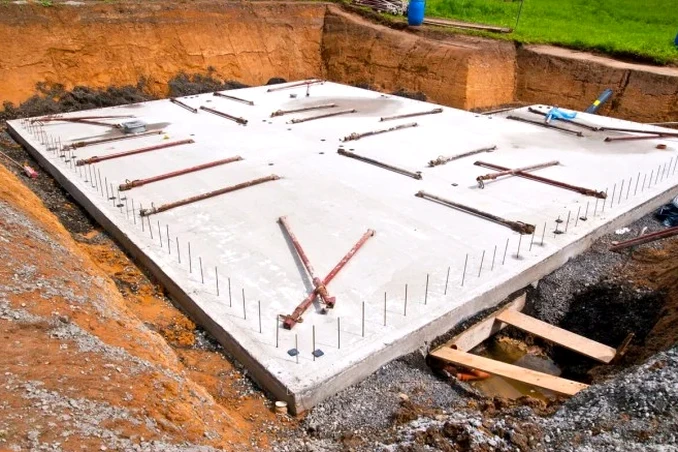
The design begins long before a single cubic meter of concrete is poured—it starts with the drilling rig. In Abbotsford, where the glacial till transitions abruptly into deep Sumas clays, our crews deploy a truck-mounted CME-75 auger rig to extract continuous Shelby tube samples at depths of 15 to 25 meters. These samples capture the transition from the surficial clay crust into the underlying dense lodgement till, which is critical data for calibrating a raft foundation's subgrade reaction modulus. Without undisturbed recovery from the saturated, low-plasticity Sumas silts, any mat design would be a gamble against differential settlement in the Fraser Valley's soft alluvium.
A properly designed raft in Abbotsford's Sumas clay doesn't eliminate settlement—it makes settlement uniform enough that the superstructure never feels the difference.
Local ground factors
The risk profile between a raft on the west side of Abbotsford in the Sumas Prairie versus one in the eastern uplands near Auguston is night and day. On the prairie, the primary hazard is edge-of-mat differential heave caused by expansive clay moisture cycles—the upper 4 m of weathered Sumas clay can swell up to 7% by volume when saturated, generating uplift pressures that easily exceed dead loads in single-story structures. In the uplands, the risk shifts to differential settlement where glacial till thins over undulating bedrock, creating a stiff-soft-stiff bearing profile that concentrates flexural cracks in the raft. Both scenarios demand a rigorous spring-constant calibration: we derive the modulus of subgrade reaction not from a textbook, but from iterative settlement analysis using the actual stratigraphy logged during the geotechnical investigation, ensuring the mat reinforcement detailing matches the predicted bending moment envelope.
Common questions
What is the typical cost range for a raft foundation design on Abbotsford's Sumas clay?
For a standard single-family or light-commercial raft on sites with up to 5 m of Sumas clay, the geotechnical investigation and structural design typically run between CA$1,420 and CA$5,430, depending on whether deep boreholes or only shallow CPT probing is required and how complex the reinforcement detailing becomes under seismic load cases.
Why choose a raft foundation instead of isolated footings in the Fraser Valley?
Raft foundations distribute the total structural load over the entire footprint, reducing the contact pressure to levels that the soft Sumas clay can sustain without excessive differential settlement. Isolated footings on this soil often require deep excavation down to competent till, which in Abbotsford can be 8 to 20 m deep, making a raft the more economical option once the groundwater cutoff and buoyancy control are properly engineered.
How does the 2015 M4.8 earthquake near Abbotsford influence raft foundation design today?
The 2015 event, centered roughly 15 km northeast of Abbotsford, reminded the engineering community that shallow crustal earthquakes can generate short-period spectral accelerations above 0.6g even on firm ground. For a raft foundation, this translates directly into the design of the mat-to-column connection and the boundary reinforcement, which must resist the seismic overturning moment without punching through the slab. Our designs incorporate the site-specific Sa(0.2) and Sa(1.0) values from the 2020 NBCC seismic hazard model for the specific latitude and longitude of the site.
Can a raft foundation be used on a sloped lot in the Auguston or Eagle Mountain areas?
Yes, though the design shifts from a uniform-thickness mat to a stepped or ribbed raft that follows the slope geometry. The key challenge in Abbotsford's upland neighborhoods is the transition zone where colluvium overlies bedrock—the upslope portion of the raft may bear on stiff till while the downslope edge sits on softer weathered material. We model this with variable spring stiffness across the mat footprint and introduce a slip joint or thickened edge beam at the downslope side to redistribute the shear.