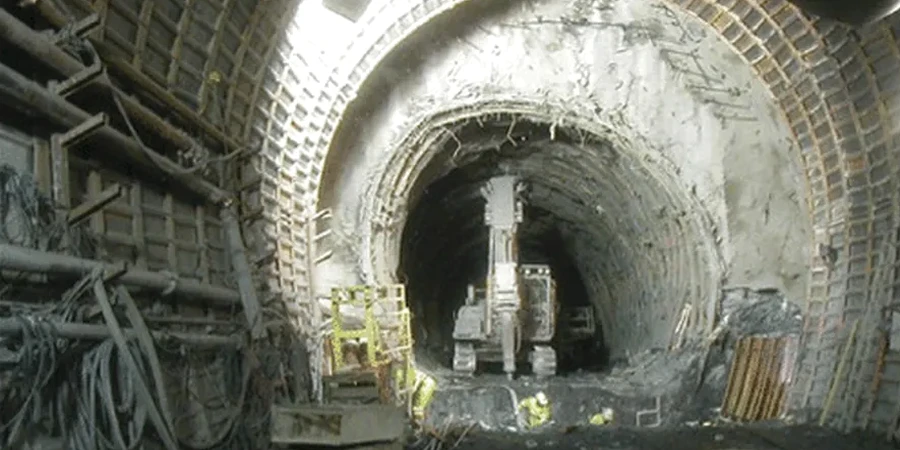
The Fraser Valley lowlands don't forgive half measures when you're opening a tunnel section through compressible silts. We saw it last year on a trunk sewer drive east of Sumas Way: the contractor hit a lens of organic clay at 6 meters that the desk study had mapped as stiff till. The crown settled 40 mm before the shield could react. That's the reality of soft ground tunneling in Abbotsford—the stratigraphy inherited from Sumas Lake and the meandering Fraser River creates pockets of very low shear strength that demand a rigorous geotechnical baseline. Our laboratory runs triaxial tests under a CSA A23.3 framework to define the undrained strength envelope the TBM operator needs before the first cut. When the alignment crosses the Matsqui flats, we complement the site characterization with CPT testing to catch those transitional zones between the Sumas Drift and the underlying glacial marine sediments, and we reference the FHWA-NHI-05 guidelines to keep the face pressure calibrated.
Effective stress parameters from CU triaxial testing are the difference between a tunnel lining that lasts 50 years and one that starts cracking in five.
Common questions
How long does a full triaxial testing program for a tunnel alignment take?
A typical package of 12 to 18 CU triaxial specimens, including consolidation and shear stages with pore pressure measurement, runs three to four weeks in our Abbotsford lab. Consolidated-drained tests add about 10 days due to the slower strain rate required for proper drainage. We can accelerate the program by batching specimens from multiple boreholes concurrently if the project schedule demands it.
What tool is used to sample the soft clay for the triaxial tests?
We specify thin-walled Shelby tubes pushed with a hydraulic piston sampler, following ASTM D1587. For the very soft organic clays found in parts of Abbotsford, a stationary-piston sampler gives better recovery and less disturbance. The tubes are sealed in the field with microcrystalline wax and transported upright to the lab within 24 hours of sampling.
What does the geotechnical analysis for an Abbotsford soft ground tunnel cost?
The budget depends on the number of boreholes, the depth of the alignment, and the triaxial testing complexity. For a typical municipal tunnel project in Abbotsford, the laboratory testing and geotechnical reporting package ranges from CA$5,290 for a limited scope to around CA$25,990 for a comprehensive program covering multiple geologic units with CU and CD triaxial, consolidation, permeability, and water chemistry.
Can you test the effect of foam conditioning on the clay's shear strength?
Yes, we run comparative triaxial tests on remolded specimens with and without the proposed foam agent at the target foam expansion ratio and injection rate. The test measures the reduction in undrained shear strength and the change in permeability that the conditioned muck will exhibit inside the plenum, which is essential for sizing the screw conveyor and setting the extraction rate.