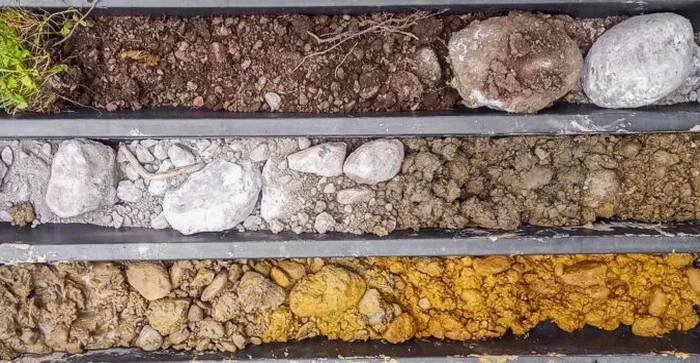
The most costly mistake we see in Abbotsford is assuming uniform soil conditions across a site. A developer broke ground near Sumas Mountain expecting dense till and hit buried organic silt at 1.2 meters — the foundation redesign cost six figures. An exploratory test pit would have revealed that lens in under three hours. Excavator access to 4.5 meters provides an uninterrupted view of stratigraphy, groundwater seepage, and construction debris that boreholes can miss. On the Matsqui Prairie side, where Sumas clay dominates, direct observation of oxidation mottling and shear planes informs drainage design before a single footing is poured. We combine field logging per ASTM D2488 with Atterberg limits when fine-grained layers need classification, and correlate findings with SPT drilling results for projects requiring deeper bearing verification. For any foundation, utility trench, or retaining wall in the Fraser Valley, a test pit eliminates the guesswork that drives change orders.
A single test pit in Abbotsford's Sumas clay can reveal shear planes, fill boundaries, and the seasonal water table in one excavation — data that drives foundation and drainage design simultaneously.
Local ground factors
Abbotsford's geology splits into two distinct risk profiles. The Sumas Prairie lowlands are underlain by up to 15 meters of compressible Sumas clay — a post-glacial lacustrine deposit with undrained shear strengths that can dip below 25 kPa in the upper crust. An exploratory test pit in this material reveals oxidation zones, root channels, and desiccation cracks that act as preferential seepage paths, accelerating consolidation settlement under load. On the upland side, glacial till over bedrock creates a different hazard: perched groundwater at the till-bedrock interface that saturates the base of excavations and triggers slope instability during the wet season. NBCC 2020 seismic provisions place Abbotsford in a moderate-to-high shaking zone, and liquefaction assessment of loose alluvial sands in the Matsqui corridor often starts with pit observations of density and fines content. Without direct visual inspection, a uniform clay assumption can mask the sand stringers that liquefy and the organic pockets that rot, leaving foundations differentially supported and utilities fractured.
Regulatory framework
ASTM D2488 — Standard Practice for Description and Identification of Soils (Visual-Manual Procedure), CSA A23.3 — Design of Concrete Structures (referenced for foundation bearing interpretation), NBCC 2020 — National Building Code of Canada, Part 4 (seismic site class and geotechnical requirements), ASTM D698 / D1557 — Standard Test Methods for Laboratory Compaction Characteristics, WorkSafeBC Part 20 — Excavation, Trenching, and Shoring safety requirements
Common questions
How much does an exploratory test pit investigation cost in Abbotsford?
For a typical single-family or light commercial site in Abbotsford with two to three pits to 3.5 m depth, the investigation ranges from CA$780 to CA$1,060. The rate includes excavator mobilization, field logging, photographic record, and a stamped summary letter. Sites requiring traffic control on busy roads like South Fraser Way, or pits deeper than 4 meters with trench box installation, will push toward the upper end due to additional safety and equipment time.
What depth can you reach with an exploratory test pit in Abbotsford soils?
With a standard 13-tonne excavator and sloped sidewalls, we typically reach 3.5 to 4.5 meters in the Sumas clay and glacial till that dominate Abbotsford. Deeper pits are possible with benching or trench box support, but beyond 5 meters the excavation becomes less cost-effective than a drill rig. Groundwater inflow in the Matsqui Prairie area often limits practical depth during the wet season, and we adjust the program accordingly.
How do exploratory test pits compare to boreholes or CPT soundings?
Test pits provide a continuous, two-dimensional exposure of the subsurface — you see layering, fill boundaries, cobble content, and seepage directly. Boreholes give point data at depth; CPT gives a continuous cone resistance profile. In Abbotsford, where uncontrolled fill from agricultural leveling is common, pits are unmatched for mapping the lateral extent of buried organics or debris. We often recommend combining pits with SPT boreholes or CPT soundings when bearing strata lie beyond excavator reach.
What happens after the test pit is backfilled — is the ground restored?
Backfill is placed in compacted lifts with density testing to match or exceed the surrounding in-situ density. For pits under future footings or slabs, we use engineered granular fill; for landscape areas, native soil is returned and the surface graded. In Abbotsford's clay-rich zones, moisture conditioning during backfill is critical — overly wet clay placed in winter will settle for months. Our field technicians monitor compaction and provide a closure report.