Together, we solve the challenges of tomorrow.
LEARN MORE →Ground improvement in Abbotsford is a specialized geotechnical engineering discipline that encompasses a suite of in‑situ soil treatment techniques designed to enhance the engineering properties of weak or compressible ground. Rather than deep foundations that bypass problematic soils, these methods modify the native material to increase bearing capacity, reduce settlement, mitigate liquefaction potential, and accelerate consolidation. In a region where the cost of traditional piling can be prohibitive and schedule constraints are tight, ground improvement offers a technically robust and often more economical alternative for supporting buildings, roadways, and industrial infrastructure on marginal land.
The local geology of Abbotsford, particularly across the low‑lying Sumas Prairie and areas adjoining the Fraser River, presents classic challenges for development. Much of the city is underlain by Holocene‑age alluvial and lacustrine deposits: soft, normally consolidated silts, clays, and loose sands that can extend to depths exceeding 15 metres. These soils are susceptible to both static settlement under load and dynamic densification or strength loss during a seismic event. The region’s moderate seismicity, driven by the Cascadia Subduction Zone and shallow crustal faults, makes post‑earthquake performance a critical design criterion. Ground improvement directly addresses these risks at the source, improving the soil rather than working around it.
Design and execution of ground improvement in Canada are governed by a framework that includes the National Building Code of Canada (NBC), the BC Building Code, and the standards published by the Canadian Geotechnical Society. The Canadian Foundation Engineering Manual (CFEM) provides the core reference for limit states design, while CSA‑S6 applies to transportation structures. Specifically, methods such as stone column design must comply with rigorous quality‑control specifications that often reference ISSMFE guidelines and local Ministry of Transportation and Infrastructure (MoTI) supplemental standards. All designs are expected to meet an ultimate limit state safety factor and serviceability criteria for post‑construction settlement, typically verified through post‑treatment in‑situ testing such as CPT, SPT, or full‑scale load tests.
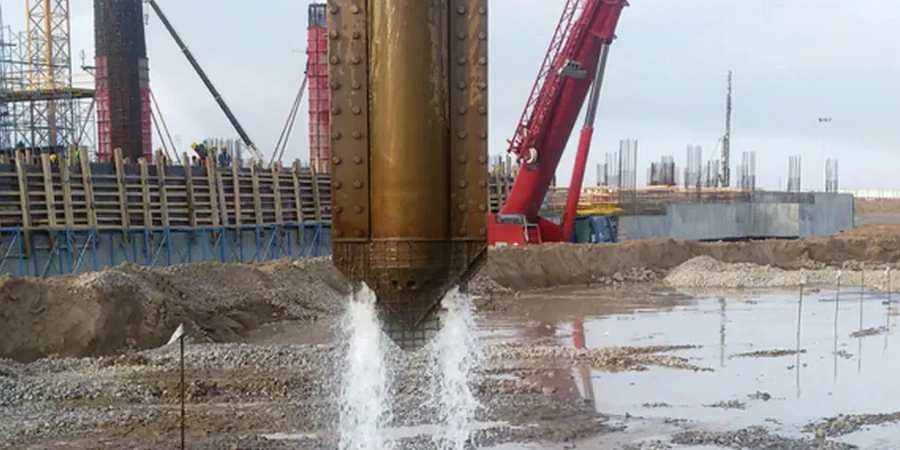
The types of projects that routinely require ground improvement in Abbotsford range from warehouse distribution centres and food‑processing plants on the prairie to low‑rise commercial buildings and approach embankments for overpasses. Where loose, saturated sands are encountered, vibrocompaction design becomes the preferred method to densify the deposit and achieve a target relative density that resists liquefaction. For cohesive or mixed‑grain soils where drainage and reinforcement are needed, stone columns provide both vertical drainage paths and composite stiffness improvement. Municipal infrastructure, including stormwater detention ponds and sanitary sewer alignments, also benefits from controlled modulus columns or deep soil mixing when crossing soft zones.
Ground improvement enhances the native soil's properties—strength, stiffness, and permeability—so it can support structural loads directly, reducing or eliminating the need for deep piles. This often lowers cost, shortens construction time, and mitigates risks like differential settlement and seismic liquefaction by treating the problem material in place rather than bypassing it.
The soft, compressible silts and clays of the Sumas Prairie and loose alluvial sands near the Fraser River are prime candidates. These deposits can settle excessively under load and are prone to strength loss during earthquakes. Ground improvement is specified when bearing capacity is inadequate or when predicted settlements exceed the serviceability limits of the planned structure.
Design follows the National Building Code of Canada and the BC Building Code, with technical guidance from the Canadian Foundation Engineering Manual (CFEM). For transportation projects, CSA‑S6 applies. Local authorities may also require adherence to BC MoTI specifications and verification testing protocols like post‑treatment CPT or SPT to confirm performance criteria are met.
Verification relies on a pre‑ and post‑treatment in‑situ testing campaign, typically using Cone Penetration Tests (CPT), Standard Penetration Tests (SPT), or geophysical methods. Load tests on treated zones may also be performed. Acceptance is based on achieving specified target values for tip resistance, relative density, or modulus, ensuring the design assumptions are satisfied.