Together, we solve the challenges of tomorrow.
LEARN MORE →In-situ testing forms the backbone of reliable geotechnical engineering in Abbotsford, providing direct measurements of soil and rock properties without the disturbance inherent in sampling and laboratory work. This category encompasses field investigations that evaluate ground conditions at their natural state, delivering critical parameters for foundation design, earthworks, and infrastructure planning. From assessing compaction quality to determining bearing capacity and permeability, these tests bridge the gap between desk-study assumptions and on-the-ground realities. In a region where subsurface variability can significantly impact construction outcomes, the value of accurate field data cannot be overstated.
Abbotsford's geology presents a complex tapestry shaped by glacial and post-glacial processes, with the Fraser River lowlands dominating much of the urban and agricultural landscape. The area is underlain by thick sequences of glaciolacustrine silts and clays, advance and retreat-phase glacial tills, and post-glacial alluvial deposits including sands and gravels of the Sumas River and its tributaries. These formations often exhibit abrupt lateral and vertical changes, with soft, compressible clays juxtaposed against dense, overconsolidated tills. The Sumas Prairie, in particular, features organic soils and peats that pose significant engineering challenges. Understanding this stratigraphic complexity demands rigorous field testing to characterize strength, compressibility, and hydraulic conductivity—parameters that cannot be confidently derived from borehole logs alone.
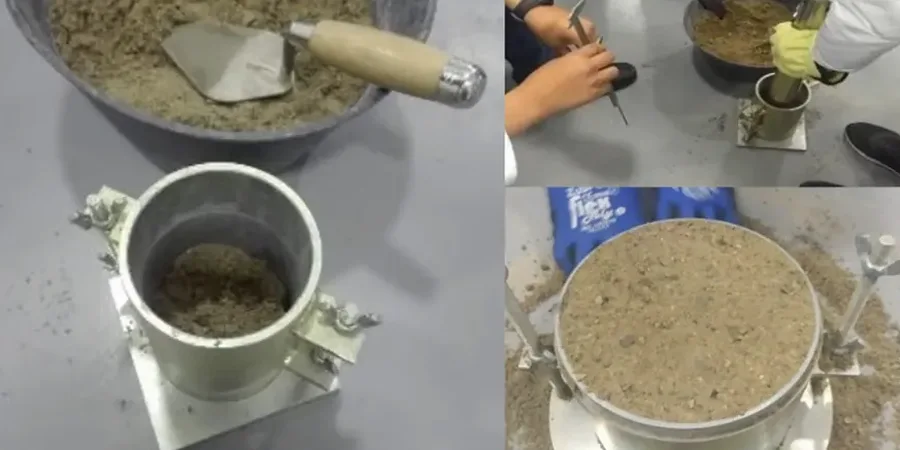
Field testing in Abbotsford is governed by the British Columbia Building Code, which references national standards under the Canadian Geotechnical Society's guidelines and ASTM International methods. The field density test (sand cone method) adheres to ASTM D1556, ensuring consistent compaction verification for structural fill and road subgrades. The plate load test (PLT) follows ASTM D1194/D1195 protocols, providing direct modulus of subgrade reaction and bearing capacity data essential for shallow foundation design. For hydraulic characterization, the field permeability test (Lefranc/Lugeon) is conducted per ASTM D6391 or the Houlsby method for rock mass permeability, critical for dewatering design and seepage analysis. Engineers practicing in the province must also adhere to Engineers and Geoscientists BC (EGBC) professional practice guidelines, which emphasize the importance of site-specific field data over generalized correlations.
The types of projects that necessitate comprehensive in-situ testing in Abbotsford are diverse and economically significant. Large-scale agricultural and industrial developments on the Sumas Prairie require extensive fill compaction verification using nuclear or sand cone density tests to prevent differential settlement. Transportation infrastructure, including Highway 1 expansions and the Abbotsford International Airport upgrades, relies on plate load tests to confirm subgrade stiffness and bearing capacity beneath runways and pavements. Residential and commercial subdivisions on the slopes of Sumas Mountain or along the Vedder River escarpment demand permeability testing to assess slope stability and groundwater control measures. Municipal projects, such as the expansion of the Abbotsford-Mission Water and Sewer Commission facilities, depend on accurate in-situ hydraulic conductivity data for the design of lagoons, infiltration basins, and pipeline trenches. Without these tests, the risks of foundation failure, excessive settlement, or groundwater-related construction delays increase substantially.
In-situ testing measures soil properties in their natural state without sample disturbance, preserving stress conditions, fabric, and moisture content. Laboratory tests require extracted samples that inevitably undergo stress relief and potential alteration during transport and preparation. Field tests like the plate load or permeability tests provide direct, large-volume assessments that better represent the overall mass behavior, whereas lab tests offer controlled, small-scale measurements of specific parameters.
In-situ testing is mandated for virtually all significant construction projects in Abbotsford, particularly those involving foundation design, earthworks, or groundwater control. The BC Building Code and EGBC guidelines require site-specific field data when soil conditions are variable, such as in the glacially-derived deposits common across the city. Projects on compressible Sumas Prairie soils, near watercourses, or involving deep excavations typically require a combination of density, bearing capacity, and permeability field tests to satisfy regulatory and geotechnical design requirements.
Selection depends on the geological context, project requirements, and the specific engineering questions at hand. A geotechnical engineer reviews the site's stratigraphy from exploratory boreholes, then matches test types to the needed design parameters. For example, a shallow foundation on glacial till may require a plate load test for bearing capacity, while a retention pond in silty soils necessitates a Lefranc permeability test. The testing program is tailored to deliver data that directly informs structural design, earthwork specifications, or environmental assessments.
Each method has inherent constraints. The sand cone density test only evaluates a shallow, near-surface volume and is influenced by operator technique. The plate load test reflects a limited depth of influence, typically one to two plate diameters, and may not capture deeper weak layers. Permeability tests can be time-consuming and their results are sensitive to borehole disturbance and groundwater conditions. A skilled geotechnical engineer integrates multiple test types and understands these limitations, never relying on a single method to characterize complex Abbotsford subsurface conditions.