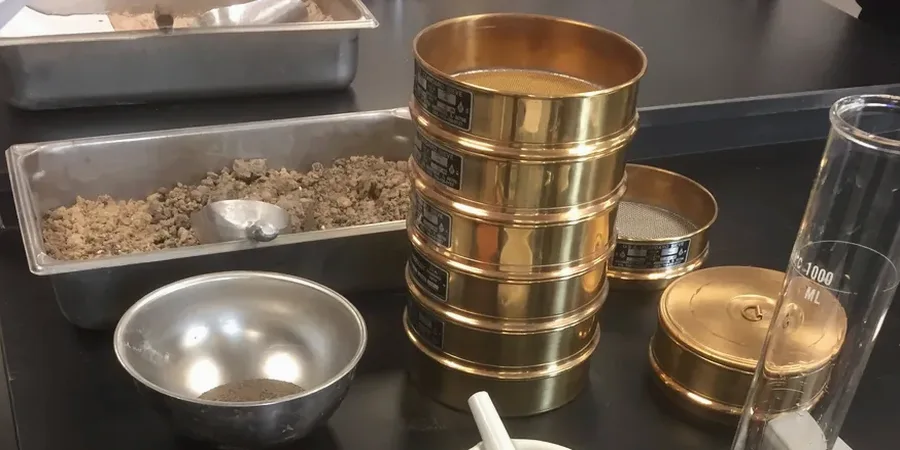
In Abbotsford, the difference between a stable foundation and long-term settlement often comes down to one overlooked detail: the true fines content. We have seen numerous projects across the Sumas Prairie and the hillside developments near McKee Peak where initial field estimates of silty sand turned out to be silt with sand after a full hydrometer run. The glacial and alluvial soils deposited by the Fraser River and its tributaries here contain a surprising amount of material passing the No. 200 sieve. A standard sieve stack alone misses this fraction entirely. Our grain size analysis combines mechanical shaking with a sedimentation hydrometer test to capture the full distribution from coarse sand down to colloidal clay. For road builders working on projects like the widening of Highway 1 near the Abbotsford-Chilliwack border, the gradation curve directly affects the CBR and pavement design assumptions. When the fines plot higher than 12 percent, the drainage characteristics change, and that matters in a region that gets over 1,500 mm of rain annually.
A hydrometer curve reveals more about drainage and frost susceptibility than a sieve stack alone — in Abbotsford's wet winters, that distinction is everything.
Process and scope
A common mistake we observe in local site investigation reports is reliance on a visual-manual classification without hydrometer backup, especially in the clay-rich tills on the slopes of Sumas Mountain. These tills can hold moisture and behave plastically even when gravel clasts are present. Our lab runs every Abbotsford sample through the full ASTM D422 procedure when fines are suspected: the sample is washed over a 75-micron sieve, the retained portion is dried and shaken through a stack from 4.75 mm down to 75 microns, while the minus-75 material is analyzed via hydrometer using a 152H type with sodium hexametaphosphate as dispersant. The resulting curve plots particle diameter on a log scale against percent passing. This single graph informs the Unified Soil Classification System symbol, the coefficient of uniformity (Cu), and the coefficient of curvature (Cc) — values that directly feed into the proctor compaction specification. For structural fill under footings in the Bradner area, we flag any material with a Cu below 6 as potentially poorly graded and subject to bridging during compaction.
Local ground factors
Abbotsford's geography spans two extremes: the freely draining gravels of the Matsqui uplands and the soft, compressible silts of the Sumas Lake bottom. The risk of misclassifying a soil here is not abstract. On a project near the former Sumas Lake bed, a contractor imported fill that appeared sandy in the borrow pit. Our hydrometer test showed 18 percent clay content. That fill, if placed without lime treatment, would have failed under the saturated conditions that return every November through March. The frost heave potential in the silty deposits along Clayburn Creek is another concern: soils with more than 3 percent finer than 0.02 mm can heave, and Abbotsford's freeze-thaw cycles are enough to lift shallow footings. The grain size curve, particularly the D10 to D30 segment, tells the engineer whether a capillary break is needed or whether the material can serve as a free-draining backfill for the retaining walls common in hillside subdivisions.
Common questions
How much does a grain size analysis cost in Abbotsford?
A combined sieve and hydrometer test typically runs between CA$120 and CA$250 per sample, depending on whether the sample requires pre-treatment for organic matter or if we are running a full stack from 75 mm down. A sieve-only analysis for clean granular material is at the lower end of that range. We can provide a firm quote once we know the number of samples and the expected fines content.
How long does the hydrometer portion take?
The hydrometer test requires a minimum of 24 hours to capture the full sedimentation curve, with readings taken at 0.5, 1, 2, 4, 8, 15, 30, 60, 120, 240, and 1440 minutes. Combined with sieve drying and weighing, the full report is typically ready in 2 to 3 business days from sample receipt.
What sample size do you need for a sieve and hydrometer test?
We need approximately 500 grams of dry material for a sand-dominant sample. For silts and clays, 200 grams is sufficient. The sample should be sealed in a plastic bag immediately after collection to preserve natural moisture if we are also running Atterberg limits. We can accept disturbed samples — undisturbed integrity is not required for grain size analysis.
Can you classify the soil type from the gradation curve?
Yes. Using the percent passing the No. 200 sieve and the shape of the curve, we assign the USCS symbol per ASTM D2487 — for example, SP-SM for poorly graded sand with silt, or CL for lean clay. This classification is included in every report and is the standard reference for Abbotsford building permit applications under the BC Building Code.